Guide
How do I get clients who need what I sell?
Look for public signs that a company needs you now: a job ad for the work you do, a page missing from their website, a funding headline. Write to that company about that sign, from your own mailbox. Follow up once, then stop.
Why the sign matters more than the list
Most advice on getting clients is a list of channels: networking, referrals, social media, a portfolio. All fine. None of it tells you who to talk to on Monday morning.
A sign does. When a company posts a job ad for a bookkeeper, it has a bookkeeping problem today, and a budget for it. When its website has no booking page, someone there is taking bookings by phone and hating it. Writing to that company about that exact thing is a different email from "we help businesses grow", and it gets read differently too.
In our plan for getting more customers, this is week 3, the week you stop waiting to be found. It works best when you sell to companies, and when you can name the problem you fix in one sentence.
- Spot a sign: A job ad, a move, a headline
- Check it is recent: This month, still open
- Find their address: The one they publish
- Write about the sign: One company, one email
- Follow up once: A week later, then stop
The signs, and where to read each one
Pick the one or two signs that fit what you sell: a bookkeeper might watch for finance job ads, say, and a web designer for broken or missing pages.
| The sign | What it tells you | Where to read it |
|---|---|---|
| A job ad for work you do | They have the problem now, and money set aside for it | Job boards, and the careers page on their own site |
| A page missing or broken on their site | Something you fix is visibly undone | Their website, opened on a phone |
| Funding or a big new contract | New money, new targets, new suppliers | Local business news and their press page |
| A new location or a move | A lot of things need setting up again | Local news, planning notices, their own posts |
| A new person in charge | New managers often review suppliers | Their posts on LinkedIn, press releases |
| A public complaint your work would fix | They are losing customers over it today | Their Google reviews |
A sign has a shelf life. A job ad that closed three months ago means the seat is filled. Check the date before you write, and say in the email where you saw it.
Doing it by hand in an hour
You don't need software to start. Set a timer for an hour a day and do this for one week. Pick the sign on the first day and keep it all week, so you can tell whether it works.
Pick one sign (10 minutes)
The one that best matches the problem you fix. Write it down as a search, like "hiring bookkeeper" plus your town. From day two, spend these minutes on yesterday's replies.
Find 10 companies showing it (20 minutes)
Note each company, the sign, the link and the date. Skip anything older than a month.
Find the address they publish (5 minutes)
The contact page, the press page or the footer. If there is only a general inbox, use it.
Write five emails (20 minutes)
First line about the sign. One sentence on what you would do. One small question. Your name, your postal address and a way to say no.
Log it (5 minutes)
Company, sign, date sent, and the date a week out for your one follow up.
The first line decides whether the rest gets read. Compare these two, both made up and both to one company.
Two first emails to the same company
Written for anyoneMade up
About the sender
Hi there,
We are a full-service bookkeeping firm helping businesses grow. We would love to hop on a quick call to discuss your goals.
Best,
Sam
It could go to any company in the country, so it reads like it did.
Written for one companyMade up
About their sign
Hi Priya,
I saw the part-time bookkeeper opening on the Harbor Kitchens careers page. While you look, I could keep your books from next week: month-end close, payroll and the sales tax filing, for a fixed monthly fee.
Worth 15 minutes on Thursday?
Sam Okafor, Okafor Books
12 Mill Lane, Dayton, OH
Not for you? Reply stop and I won't write again.
It names the sign and where it was seen, offers one thing, asks one small question, and carries a postal address and a way out.
The last two lines of the second email are there because the law asks for them. In the US the FTC's CAN-SPAM rules cover this kind of email, and its guide is blunt about it:
The law makes no exception for business-to-business email.
The same guide says your message must include your valid physical postal address and a clear way to opt out, and that you must honor an opt-out within 10 business days. Those are the US rules. If you write to companies in other countries, check their rules first. We don't cover them here. Our cold email guide goes further into subject lines, follow ups and staying out of spam.
Mistakes that kill the reply rate
- Guessing personal addresses. firstname@company.com often bounces or reaches the wrong person. Use the address the company publishes.
- Pasting a pitch into their contact form. It lands with whoever handles customer questions, who has no reason to pass it on.
- Opening with yourself. The first line is about them and the sign. Your company name can wait for the signature.
- Following up three times. One follow up, a week later, that adds something. After that, silence is the answer.
- Buying a list instead. A bought list has no signs on it, so every email has to be the generic one. If you are weighing it anyway, read pay per lead first.
- Writing to fifty companies on the first day. Send five a day for the week, then read the replies and decide whether the sign is worth keeping.
Handing the hour to Hunter and Mo
Everything above works by hand. If you would rather not spend the hour, two of our agents can take it off your hands.
Hunter, our Lead Finder, starts from the customer you describe, say "property managers in Texas", then reads job ads, maps and news for companies showing a sign they need you. Each company arrives with the reason it was picked and the best way to reach it: a published email, an info@ address flagged as unconfirmed, or a phone number. Here is a real run from 7 Nov 2026 for cursor.com, the website we use as a demo:
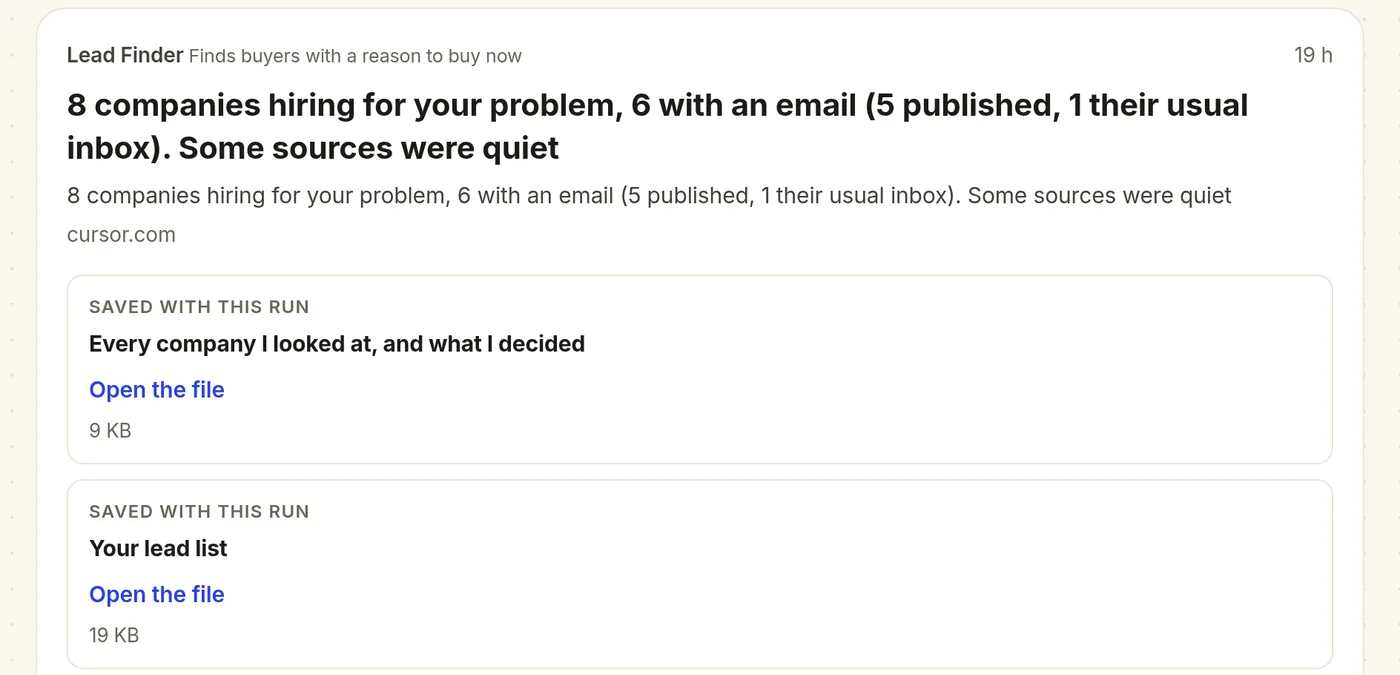
The run found no email for 2 of the 8. Expect that on your own list: for some companies with a clear sign, a phone number is the only way in.
Then Mo, our Cold Email Agent, reads each company quickly and writes one email per company, about that company's sign. In the same demo run Mo wrote 6, about 60 words each on average. Every one was waiting on the same detail before it could go: the sender's postal address, the CAN-SPAM line above. Once that is in, each email is ready to go out from your own mailbox, at a steady pace. None are sent from ours.


Buying signals you can watch yourself
Some clients are worth waiting for. Write down the 20 companies you would most like to work with, and once a month check four things for each: their careers page, their news, their website (a new pricing page or a new service often means a new plan), and who just joined their leadership. When something changes, that is your sign, and your email.
Abe, our Target Account Watch agent, follows the accounts you name and watches their hiring, news and website changes. When something moves, he says why it matters to you and drafts your opening line. Expect long quiet spells with small private firms: they can go months without changing anything in public.
The three who look for signs and write the first email
Lead Finder
Hunter, Go-getter
Finds buyers with a reason to buy now
- Weekly
- Ready now
Can't: Personal emails are never guessed. Only an address the company publishes, or its usual info@ inbox marked as not confirmed. It never fills or sends a contact form for you.
Hunter, off duty: Can smell a warm lead.
Cold Email Agent
Mo, Go-getter
Writes a different first email for each company Hunter finds, ready to send from your own mailbox, batch by batch
- Weekly
- Ready now
Can't: Every email is checked before it goes. Nothing is sent from our mail, only from your own, and every email carries a way to unsubscribe. Where your mailbox allows it, we check recent mail only for replies, so follow ups stop. Your mail is never given to AI.
Mo, off duty: Writes first lines that get replies.
Target Account Watch
Abe, Analyst
Tells you when something changes at a company you want to win
- Weekly
- Ready now
Can't: Private company data is limited.
Abe, off duty: Keeps a file on every dream client.
This way of finding clients is wrong for you if your buyers are people at home, not companies. The signs on this page are company signs. A plumber or a hairdresser will do better starting with the map and reviews: see weeks 1 and 2 of how to find customers.
Questions about finding clients this way
What if a company only lists a general inbox like info@?
Use it, and say in your first line who you hope it reaches, for example the person running the bookkeeping search. Someone reads that inbox and forwards what looks relevant. A clear sign in the first line makes forwarding easy.
Should I attach my brochure or price list?
Not to the first email. An attachment from a stranger is one more reason to be wary, and it turns the email back into being about you. Keep the price list ready and send it when they ask, or put a link to it in your follow up.
Should I use LinkedIn instead of email?
Use whichever the person really reads. The rule doesn't change: name the sign, offer one thing and ask one small question. A connection request with a sales pitch attached gets ignored for the same reason a generic email does.
What if nobody replies?
Change the sign before you change the volume. If a week of emails about one sign gets no answers, that sign may not mean what you thought it did for your kind of work. Try the next one on the list.
Sources
- FTC: CAN-SPAM Act, a compliance guide for business Checked on 8 Nov 2026
How we made this page
Written by the Writecream team from the FTC's CAN-SPAM guide, read on 8 Nov 2026, and from screens of a demo run of our crew on 7 Nov 2026 for cursor.com, a website we use as a demo. It is not a customer, and the companies on its list are blurred. The two emails are made up. AI tools helped with research and a first draft. A person checked every line against the sources and against what the product does today.
Checked by The Writecream team on . First published .
Change log
- Published