Optimising content for Google is more complex than determining the keywords. Since content is indexed by the likes of Google based on structure, depth, and relevance to the intention behind the query, many nicely written articles get left behind if the content is not SEO-friendly.
SEO writing fills this gap in terms of aligning with search intent and including related subtopics of the kind the searcher wants. Though the process of SEO writing itself is apparently complex for a newcomer, AI systems make it simpler for researching, organising, and optimising the process. In this tutorial, you’ll learn about utilising AI for writing for SEO and about where tools like Lexi from Writecream fit when it comes to creating an article.
When Should You Write an SEO Article?
In situations where you are trying to drive traffic to your site instead of sharing information with people you already know, SEO articles would be the most helpful.
Content you create for Google searches is known as SEO articles, and you need to consider using such content:
- If you are interested in Google search optimisation,
- If you need the content you create to answer searchers,
- If you are trying to create long-form content,
- If you need to update old content, or
- If you need insight into content coverage.
SEO is most effective when it is planned for writing and helps in making write-ups in accordance with data rather than assumptions.
Why SEO is Important for Article Writing
SEO is a very important process in making the search engines understand the relevancy of your content. Even the best content might not rank high if your content is not aligned in terms of user intent and the standards of competition.
SEO assists in:
- Linking content to what users are searching for
- Ensuring articles are on topics of relevance and to a certain level of detail.
- Enhancing Content Organisation for Readability & Indexing
- More visibility in competitive search results
Writing without SEO means writing without direction. Optimisation for search engines gives a writer a sense of direction or a path through which search engines can determine the worth of your article. Focusing on local SEO for therapist practices can help ensure your services appear in relevant searches, attracting nearby clients actively seeking your support.
Challenges of Writing SEO Articles Manually
For beginners, writing SEO articles manually can be challenging. Common difficulties include:
- Choosing the right target keyword,
- understanding user search intent,
- analysing competitor content,
- deciding on sections and headings, and
- knowing when the article is optimised enough to publish.
How AI Helps SEO Article Writing
AI is most effective in SEO writing when it supports research and direction rather than controlling the writing process.
Well-designed AI tools help analyse:
- Search results
- Competitor pages,
- identify common topics,
- suggest content structure, and
- Provide optimisation feedback as you write.
Writecream’s Lexi AI is built specifically for SEO-focused workflows. Instead of acting as a general writing tool, it uses real search data and competitive insights to guide both research and content creation.
Step-by-Step Guide: Write an SEO Article Using Lexi AI
Step 1: Select a Topic and a Target Keyword
All SEO articles start with a topic and a keyword on which the topic is based. The keyword is the information that the user is searching for when they click on the link.
When selecting a keyword:
- Think about what problem the reader is trying to solve.
- Refrain from multiple unrelated intents within the same article
A well-defined keyword helps focus the content on the theme of the content, which makes it easier to be recognised by the Search Engines.

Step 2: Perform SEO Research Using Lexi AI
Now, after choosing the keyword, it’s time to conduct SEO Research using Lexi AI. To begin with, follow the steps:
- Open the Writecream SEO Editor
- Click New Research
- Target keyword
- Country Selection
- Language Selection
- Click Start
Selecting the right country and language matters since search engine results depend on the country chosen. Lexi AI examines the very same search engine results your target audience examines.

Step 3: Search Intent and Competitor Analysis
After starting the research, Lexi AI analyses the top-ranking Google pages, which usually takes a few minutes. During this process,
- It reviews competitor content,
- identifies commonly covered topics,
- highlights gaps or opportunities, and
- determines overall search intent.
Once the analysis is complete, you can view the competitive landscape to understand what type of content Google favours and how your article can add value.

Step 4: Transitioning from Research to Composition
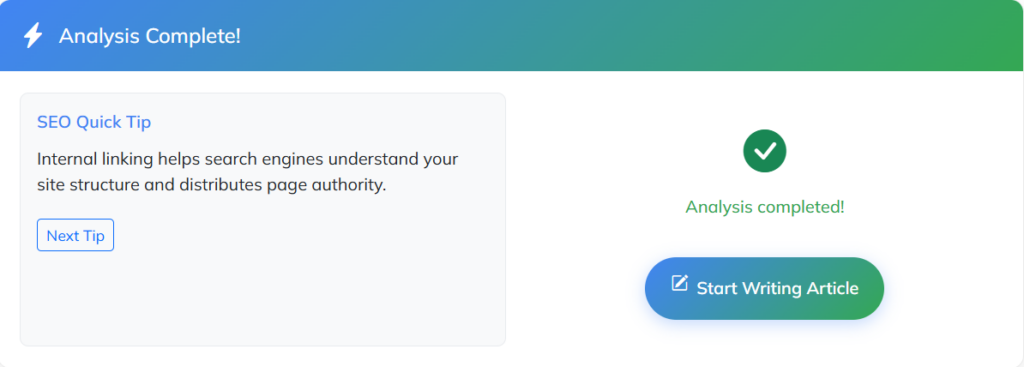
Once you go through the findings, click Start Writing Article to access the SEO Editor. You are placed inside a writing space, where:
- AI-assisted draft writing may be accomplished
- The SEO scores are updated on a real-time basis.
- Suggestions for optimisation will come up along with the content you are
At this point, you stop guessing what to write, and the research directs you on what to do.
Step 5: Writing Your SEO Article Using AI Assistance and Real-Time Guidance
When your research is done and your outline is ready, the SEO Editor then leads you into the drafting stage in an assisted workflow. When you are in the editor, the first page is “Welcome to SEO Editor” with the following two options:
- Writing New Document: start writing manually in a blank editor
- Write Article with AI: get AI help in writing an initial draft

For beginners, choosing “Write Article with AI” is a helpful starting point, especially if you’re unsure how to structure the article. This option introduces ContentCraft AI, the content assistance layer within the Writecream SEO Editor.
ContentCraft AI helps generate structured, engaging content while still allowing you to manually review and edit everything. Click Start to continue.

To create the article title and description
You can create the title and meta description of the article. In the input field, type your topic or key term: for example, SEO.
This question serves as the basis for:
- Title Generation
- Description generation
- Outline creation
- SEO scoring in the later editor
Click on Generate once you provide your query. You’ll notice fields for Title and Description that are now available for entry. This is an important step, so do not consider this a final output. You need to:

Use more precise language to better reflect your meaning. Keep it clear, concise, and reader-centred. Try to avoid very general or promotional expressions.
After that, click Create Outline.
Reviewing and Customising the Document Outline
Next, the SEO Editor generates a Document Outline with structured information using H1, H2, H3, and sometimes H4 heading elements.
This outline is based on:
- Most competitive analytical pages
- Common topic coverage
- Search intent patterns
You can click on any heading to edit it directly. This is the right moment to:
- Use simpler headings for complex titles
- Delete unnecessary sections
- Modify pacing according to your audience
Please keep in mind that the outline provided is a guideline. Click on the “Generate Paragraphs” button when you’re ready to proceed.

Evaluation for AI-Generated Content
Once the paragraphs are generated, the editor displays the Generated Content view, showing a draft under each heading.
At this stage, carefully review each section. Look for generic or repetitive content and refine it where needed. Add examples for clarity and improve the content section by section directly within the editor.
Step 6: Optimise, edit, and finalise your article before its publication.
The final step, with the draft in place, is optimisation and review. This is where you take a good draft and make it a high-quality, publish-ready SEO article.
Edit for Human Readability
Go through the SEO article from top to bottom and ask:
- Does this sound natural when read out loud?
- Are the explanations clear to a beginner?
- Does each section really help the reader?
Some writers also run sections through an AI humanizer to smooth out robotic phrasing and make the text feel more natural for readers.

Use SEO Feedback Thoughtfully
While you edit, the SEO Editor updates suggestions and scoring in real time. Use these insights to:
- Improve topic coverage
- Balance keyword usage
- Strengthen weak sections.
However, avoid following suggestions blindly. SEO guidance should support your decisions, not replace them.
Refine AI-Generated Sections
AI-generated content should always be reviewed and enhanced. Ensure:
- The data is true.
- The wording feels original.
- The tone is consistent throughout the article.
This is a quintessential step to ensure that whatever information one is seeking is both original and useful.
Final Review Inside the Content Editor
In the final level, you can evaluate your article within the Content Editor. Your SEO score changes in real-time based on how you modify the title, headings, keywords, and word count.
Use this feedback to refine your content without over-optimisation. Emphasise headings, organic keywords, and flow. Refine your generic-sounding parts written by the AI algorithm.

Before saving, read your article once to ensure that it looks like a valuable and human article to read. Click Save again to complete your SEO article.
Understanding the SEO Writing Environment
The Writecream SEO Editor assists in the writing process. The major components of the Writecream SEO Editor are:
- The Editor area: The area where the text will be written and/or edited.
- SEO score panel: real-time feedback for optimisation
- Analysis tabs: Find answers to frequently asked questions about AI writing tools by pressing this button
- Suggestions panel: Actionable recommendations
Since the editor is updating in real-time, the process of optimisation is continually taking place rather than being part of an end process.
Best Practices for SEO Article Writing with AI
- All artificially generated text needs to be reviewed and edited.
- Write for readers first, then for search engines
- Use SEO suggestions as guidelines rather than specific rules
- Write in the present
Common Mistakes To Avoid
Relying solely on AI-generated content without considering appropriate analysis can also prove to be a blunder. Overemphasis on the use of keywords without taking into account the intention of the search can also prove to make things blunderous for you.
Conclusion
Writing an SEO article with AI becomes far more manageable when you follow a structured workflow. By combining search intent analysis, competitor insights, and AI-powered guidance from tools like Lexi AI, you can create content that aligns with both user needs and search engine expectations.