What if your marketing emails could adapt and respond like a real conversation? They would feel more personal and timely than broadcasts.
For years, email worked only one way. Brands sent you messages, and you either read them or moved on. That model is changing rapidly. Now, Conversational AI in Email Marketing feel more like a two-way conversation. Relevance is more important than volume these days.
Also, you now expect brands to understand your needs and respond quickly. Conversational AI in Email Marketing makes this possible by understanding language, learning from behaviour, and adjusting responses. In short, emails feel less like campaigns and more like conversations that build trust and long-term engagement.
What Conversational AI Means for Email Marketing
Conversational AI is changing how you use email marketing. Instead of simple messages, email now supports real interaction. Emails no longer stop at a click or are ignored. Instead, they continue as conversations inside the inbox. This makes email feel more natural and useful to you.
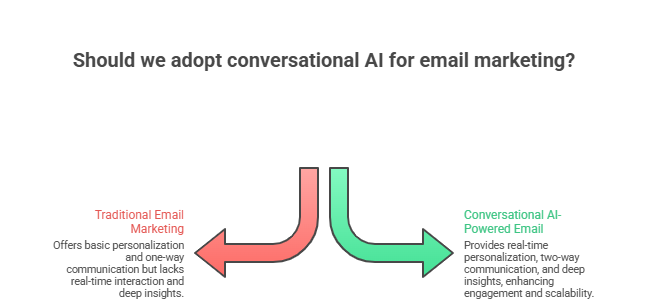
The table below shows how Conversational AI in Email Marketing changes your email marketing experience. It helps you move away from one-way messages. Instead, you create emails that listen and respond, so communication feels more natural. You also get better engagement without extra effort.
| Aspect | Traditional Email Marketing | Conversational AI-Powered Email |
| Communication Style | One-way broadcast | Two-way interactive conversation |
| Personalization | Basic segments and name tokens | Real-time and intent-based personalization |
| Response Time | Manual or delayed replies | Automated and instant responses |
| Engagement | Clicks and opens only | Replies, questions, and interactions |
| Scalability | Hard to manage at scale | Easy to scale with AI support |
| Insights | Basic performance data | Deep intent and conversation insights |
From Single-Sided Messages to Conversations
Conventional email marketing works as a one-way broadcast channel. It is based on traditional marketing methods where brands send you a message, and you read it. With time, this approach started to feel distant and impersonal. But Conversational AI in Email Marketing changes this by enabling two-way communication inside the email.
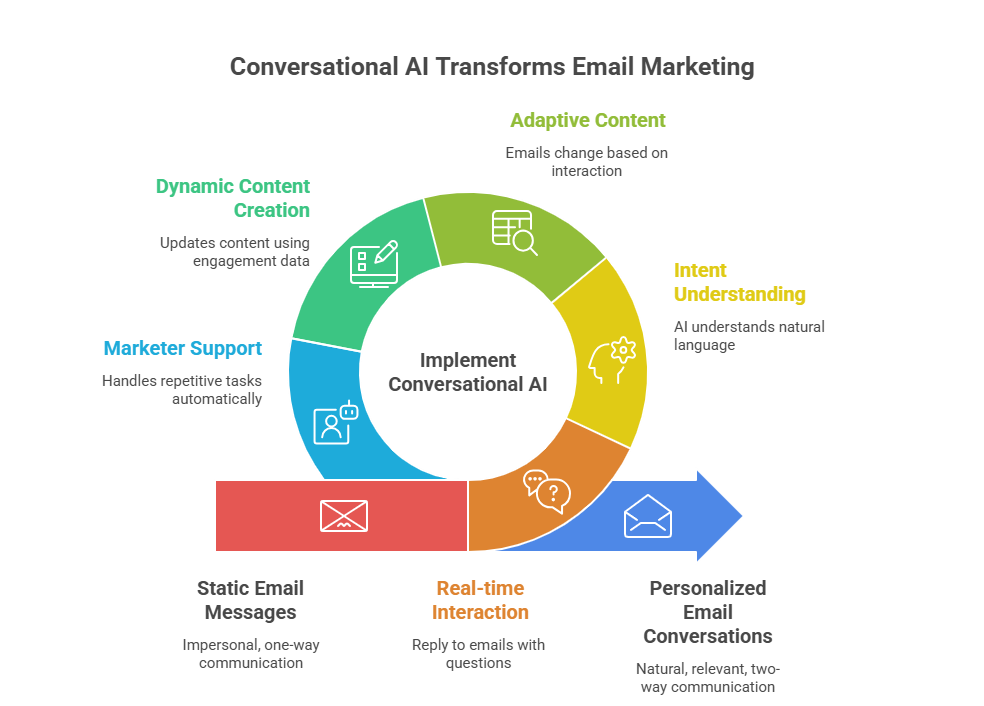
With Conversational AI in Email Marketing:
- You can respond to marketing emails, ask questions, or make requests.
- The AI understands natural language and your intent. For instance, AI learns by viewing Twitter, Reddit, and Quora threads.
- You will get instant answers without needing to wait for a human response.
- Chats keep rolling without having to change the channel.
Intent-Driven and Adaptive Emails
Conversational AI recognizes whether you intend to ask a question or make a statement and modifies email content according to your interest. Emails are no longer static the moment they enter your possession. Instead, they change and improve with each response. Because of this, communication feels more relevant. You always receive information that matches your needs.
This enables:
- Real-time follow-ups based on your replies.
- Messages tailored to your interests.
- Context-aware responses using past interactions.
- Intelligent nurturing that matches your journey.
For instance, if you inquire about pricing, the AI will respond to you with an answer in no time.
Real-Time Dynamic Content
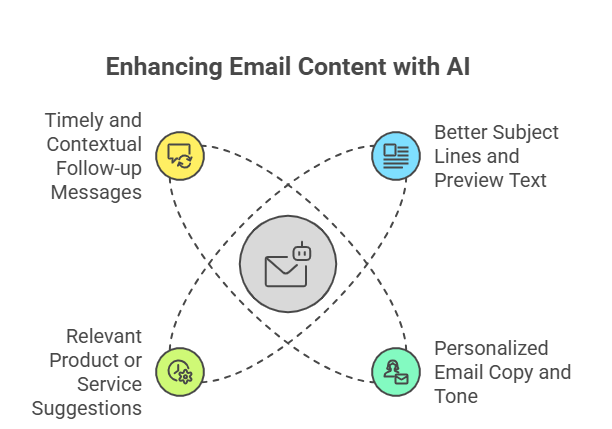
Conversational AI also improves how email content gets created. Instead of using simple templates, it updates content using engaging data, so the emails feel timely and personal. You receive messages that fit your situation. This makes communication feel more natural.
This includes:
- Better subject lines and preview text.
- Personalized email copy using AI email writing prompts and tone.
- Relevant product or service suggestions.
- Timely and contextual follow-up messages.
Supporting Marketers, Not Replacing Them
Conversational AI doesn’t replace marketers. Instead, it helps them by taking care of repetitive tasks, helping teams improve email productivity and focus on higher-value work. This reduces manual work and saves time.
It helps by:
- Managing routine customer questions automatically, improving overall email management.
- Handling large volumes of conversations efficiently.
- Analyzing interaction data for insights.
- Learning over time to improve responses.
Key Benefits of Conversational AI in Emails
In addition to automation, conversational AI changes the way you email. It makes your emails look responsive and natural rather than scripted. It also allows you to connect with many people without losing the personal touch.
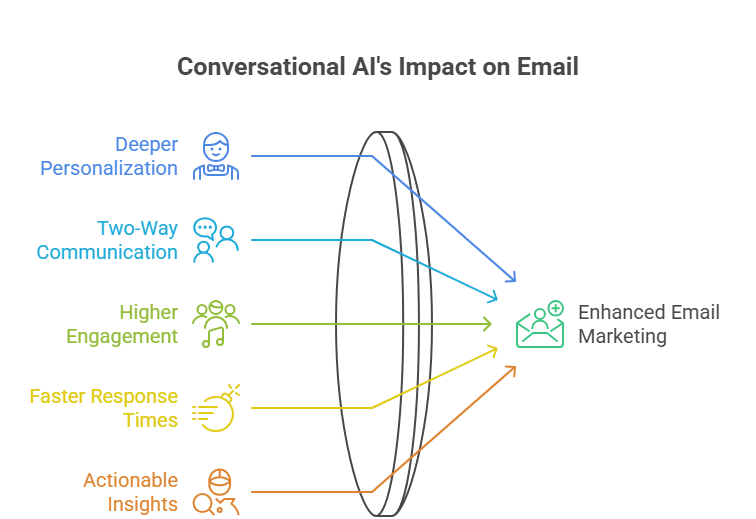
1. Deeper Personalization at Scale
Conversational AI goes beyond names or past purchases. It watches how you act and what you care about. Then it changes the message and the tone. The net effect is that your emails sound natural and are relevant.
This approach is increasingly extended through AI personalized video campaigns, where tailored video messages adapt content, visuals, and delivery to individual recipients, helping brands enhance one-to-one communication while maintaining authenticity and engagement.
2. Two-Way Communication
With traditional email marketing, you read messages but seldom respond to them. However, conversational AI changes this. Now you can ask questions and receive clear answers directly from your inbox, often through interactive workflows powered by online form builders. This makes the experience simple and fluid.
3. Improved Engagement and Open Rates
Conversational AI makes emails more interesting by optimizing subject lines, previews, and replies with real interaction data. This prompts recipients to reply, rather than just scroll by. In fact, AI-driven personalization can improve email click-through rates by up to 50%. For this, it is clear that conversational experiences boost engagement and inbox performance.
4. Faster Response Times
Speed matters more than ever. Conversational AI answers your questions instantly. Whether you’re asking about pricing or availability, you get immediate responses that keep you engaged and moving forward.
5. Actionable Insights from Conversations
You learn something useful from every interaction. This continuous learning process is vital for effective customer profile management, as Conversational AI stores information about customers: what they like, what they’re going to do, and so on. Conversational AI stores information about customers: what they like, what they’re going to do, and so on. You can use this information to make your messaging more effective. The system learns and gets smarter as it goes, and it amounts to more productive future emails.
How Brands Are Adopting Conversational AI in Email
In several industries, brands are using conversational AI in all possible ways. They don’t treat it as an experiment anymore. Instead, brands see it shaping real email strategies that deliver results. Rather than sending static campaigns, brands build emails that adapt to how you respond.
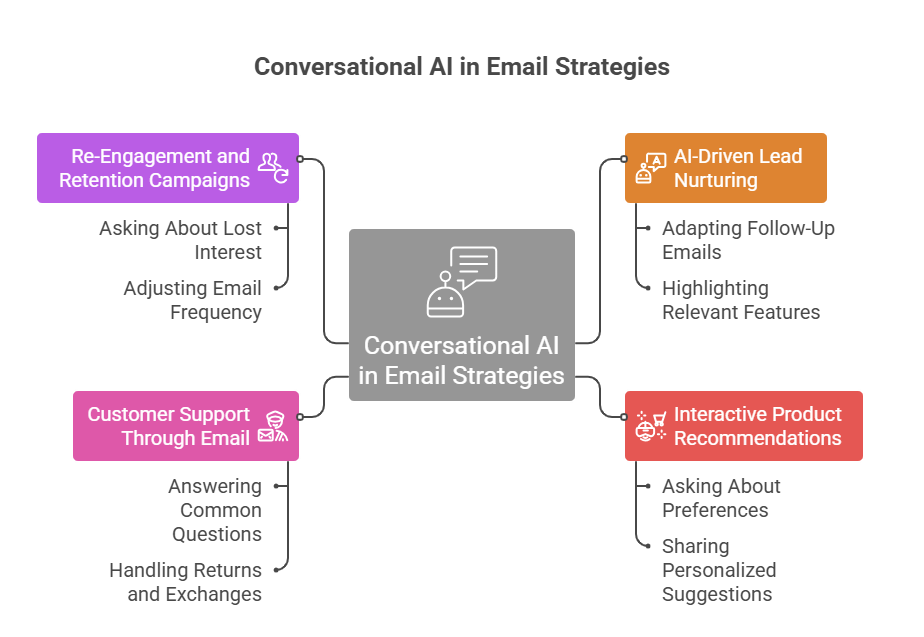
AI-Driven Lead Nurturing
Conversational AI learns from responses or interactions, gets to know customers’ interests, and eventually knows their intent. Later, it personalizes messages to match where you are on that journey.
Brands may apply this for:
- Personalizing follow-up emails based on a response or an activity.
- Highlighting features or benefits brands care about.
- Delaying or accelerating messages according to their purpose.
- Minimizing irrelevant emails that cause disengagement.
Interactive Product Recommendations
Retail and e-commerce brands are adding conversational AI to promotional emails. Instead of pushing generic offers, they invite you to engage, often using tools like a QR code generator to seamlessly connect email campaigns with landing pages, product catalogs, or exclusive offers. These emails ask simple questions to guide you. Then, they respond with helpful suggestions. This makes shopping easier and more personal.
A few common use cases include:
- Checking your budget or preferences.
- Sharing personalized product suggestions.
- Offering upgrades or alternatives based on replies.
- Adjusting recommendations as the conversation continues.
This feels like talking to a helpful store assistant. However, it happens right inside your inbox.
Customer Support Through Email
Previously, it was crucial for brands to use email finders to get email addresses for customer support. Now, many brands now use conversational AI for first-level email support. . This reduces waiting time and repeated messages. You get quick answers without frustration. At the same time, the conversation stays clear and organized. Support feels easier and faster. These tools automatically track email performance that help sales teams to prepare reports quickly.
Brands may use conversational AI to:
- Answer common questions instantly.
- Share order and delivery updates.
- Handle returns, exchanges, and account requests.
- Keep conversation history for smooth handoffs.
When issues become complex, the AI passes them to a human agent. It also shares the full context to avoid repetition.
Re-Engagement Campaigns
For brands, Conversational AI in Email Marketing can be used to re-engage inactive subscribers, and using email verification tools beforehand helps ensure those conversations reach real, active inboxes. Rather than sending reminders, brands begin real conversations. They ask why you stopped engaging. Then, they listen and respond. This makes re-engagement feel respectful.
These campaigns often focus on:
- Asking why you lost interest.
- Learning what content or offers you prefer.
- Adjusting email frequency based on feedback.
- Personalizing future messages to match interests.
By listening first, brands rebuild trust. Re-engagement feels helpful, not pushy.
Overall, Conversational AI in Email Marketing gives you more control and flexibility. You respond faster and understand your audience better. At the same time, your emails feel more personal. This makes your email strategy stronger and more effective.
From Automation to Conversation: The Next Chapter of Email Marketing
The future of email marketing goes beyond basic automation with Conversational AI in Email Marketing. It helps your email recognize intent, adapt content, and respond in real-time. And instead of static campaigns, you can create messages that react to individual behavior and interests. You also make deeper connections at scale.
This shift is already taking place now. Those same concepts are now being used by brands across a variety of industries in conversational emails that help them stand out in crowded inboxes. You no longer rely on guesswork alone.
If your email marketing is still based on basic templates and one-way campaigns, it’s time to evolve. Take a look at your present email workflows and explore what Writecream can do to help you write more conversational and AI-powered emails.