Introduction
Ranking on Google today is no longer about using one keyword repeatedly. Search engines have evolved to understand context, intent, and meaning behind search queries. This is where advanced keywords, LSI keywords, and semantic SEO become essential for modern content creation.
Advanced keywords help you target more specific and high-intent searches, while LSI (Latent Semantic Indexing) keywords and semantic SEO ensure that your content fully covers a topic in a natural and meaningful way. Instead of focusing only on exact-match keywords, semantic SEO helps Google understand what your content is about as a whole.
With the Lexi AI Agent inside the Writecream SEO Editor, mastering advanced keywords and semantic SEO becomes structured and effortless. Lexi AI analyzes top-ranking content, understands topic relationships, and identifies relevant keyword clusters that improve content depth and relevance.
By using Lexi AI insights, you can create content that aligns with Google’s algorithm updates, matches user intent, and ranks higher by covering topics comprehensively rather than superficially.
Why Advanced Keywords, LSI & Semantic SEO Are Important
- Helps Google clearly understand the topic and context of your content
- Improves ranking potential for multiple related keywords, not just one
- Matches modern search behavior where users search conversationally
- Increases topical authority and content relevance
- Reduces keyword stuffing by promoting natural keyword usage
- Helps content rank for voice search and AI-driven search results
- Improves user experience by answering related questions in one article
- Makes your content future-proof against algorithm updates
When Should You Use Advanced Keywords & Semantic SEO?
You should focus on advanced keywords and semantic SEO:
- When writing long-form or pillar content
- When targeting competitive keywords
- When your content ranks but doesn’t reach top positions
- When updating old articles to improve relevance
- When targeting voice search and conversational queries
- When building topical authority in a niche
- When Google rankings fluctuate due to algorithm updates
Step-by-Step Guide: How to Use Lexi AI for Advanced Keywords & Semantic SEO
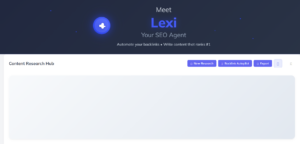
Step 1: Open the Writecream SEO Editor
To begin optimizing your content with advanced keywords and semantic SEO, open the Writecream SEO Editor.
Follow these steps:
- Log in to your Writecream dashboard
- Navigate to the SEO Tools section
- Open the Lexi AI Agent & SEO Editor using this link:
👉 https://app.writecream.com/seo-query
Once the editor opens, Lexi AI prepares to analyze semantic relationships, keyword clusters, and topical coverage for your selected keyword.
At this stage, you are laying the semantic foundation of your content, ensuring that your article covers the topic completely and naturally.
Step 2: What Lexi AI Agent Does for Semantic SEO
Lexi AI goes beyond basic keyword research. It functions as a semantic SEO and topic-mapping assistant.
Lexi AI helps you by:
- Identifying advanced and long-tail keyword variations
- Finding LSI keywords related to your main topic
- Grouping keywords into semantic clusters
- Understanding search intent behind each keyword
- Analyzing how top-ranking pages cover the topic
- Detecting missing subtopics and content gaps
- Suggesting contextual keywords for natural placement
Think of Lexi AI as your content intelligence engine that ensures your article answers everything users and Google expect from a topic.
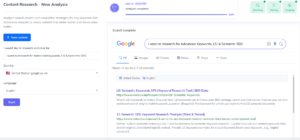
Step 3: Start Advanced Keyword Research
To begin:
- Click on “New Research”
- Enter your main keyword (example: semantic SEO techniques)
- Select your target country
- Choose the content language
- Click on “Start”
Lexi AI will now analyze not just keyword volume, but also semantic relevance, contextual usage, and intent-based variations. Choosing the correct location and language ensures Lexi AI studies the exact search behavior of your target audience.
Step 4: How Lexi AI Builds Semantic Keyword Clusters
Once the research starts, Lexi AI analyzes the SERP deeply.
Behind the scenes, Lexi AI:
- Scans top-ranking competitor pages
- Extracts commonly used contextual keywords
- Identifies topic relationships and subtopics
- Maps keyword clusters based on meaning
- Detects overused and underused terms
- Finds semantic gaps you can leverage
This process ensures your content is topically complete, not just keyword-optimized.
Step 5: Review Advanced Keyword & Semantic Insights
After analysis, Lexi AI presents a structured overview:
You will see:
- Primary and secondary keyword clusters
- LSI and contextual keyword suggestions
- Related questions and topic expansions
- Competitor topic coverage comparison
- Search intent breakdown
- Missing sections your article should include
These insights help you create content that satisfies Google’s semantic understanding and user expectations at the same time.
Step 6: Start Writing with Semantic SEO in Mind
Click “Start Writing Article” to enter the writing phase.
At this stage:
- AI-generated content uses semantic keyword placement
- SEO score updates in real time
- Suggestions guide keyword density naturally
- Topic coverage improves automatically
Lexi AI ensures your article flows naturally while covering all relevant subtopics, improving both readability and rankings.
Understanding the SEO Editor Layout
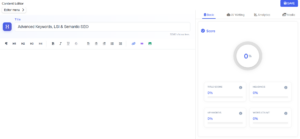
Inside the SEO Editor, you will see:
- Editor Area – Write and structure your content
- SEO Score Panel – Tracks optimization and semantic depth
- Analysis Tabs – Keyword clusters, AI tools, and insights
- Suggestions Panel – Context-based improvement tips.
- The real-time system ensures your content becomes more semantically rich as you write.
Tips for Best Results
- Focus on topic coverage, not keyword repetition
- Use LSI keywords naturally within context
- Follow semantic clusters instead of single keywords
- Answer related questions within the same article
- Write for humans first, search engines second
- Regularly update content to maintain topical relevance
Mistakes to Avoid
- Stuffing LSI keywords unnaturally
- Writing content around one keyword only
- Ignoring search intent behind keyword variations
- Copying competitor structures without adding depth
- Publishing content without reviewing semantic gaps
Conclusion
Advanced keywords, LSI, and semantic SEO help search engines understand your content the way humans do. Instead of optimizing for one phrase, you optimize for meaning, intent, and context.
With the Lexi AI Agent inside the Writecream SEO Editor, semantic SEO becomes simple, structured, and data driven. You get everything you need to create content that ranks, engages readers, and stays relevant in the long run.
Start Now
Try the Writecream SEO Editor:
👉 https://app.writecream.com/seo-query
Start building semantically optimized content today and stay ahead in search rankings 🚀