Demos are often the last threshold for UK SaaS companies, when a decision is left to the customer. We raise interest through marketing, secure appointments for sales, and the product most likely co-developed with a trusted SaaS development agency is nearly always ready. With these aspects to their merit, yet many of these demos do not lead to any scroll.
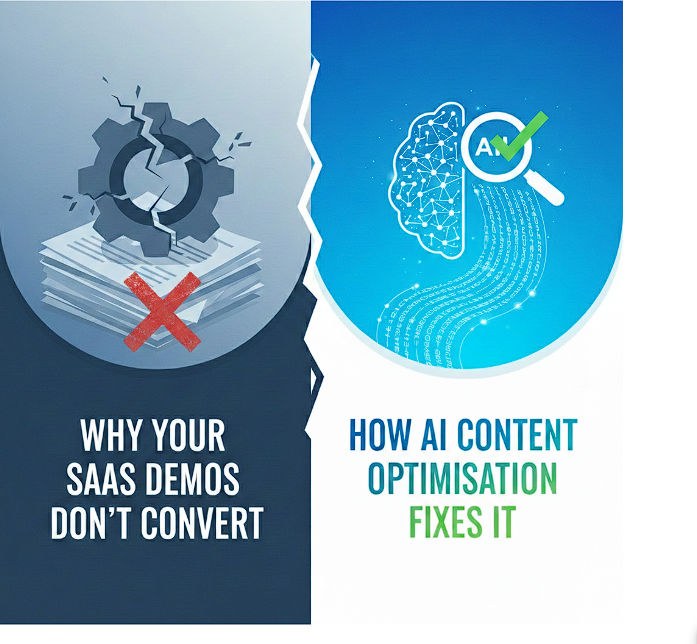
Product capability is essentially not to blame. It is more about how to position and present the product during a demonstration. Today’s potential clients come prepared with knowledge and expect precise information, leaving no room for broad or vague material. AI content optimisation brings up the concept of demos-as-conversion-focused bodies on relevance, clarity, and personalisation. Every demonstration should resonate with the practical business needs of the requesting party and deliver lots of juicy conversion lifts.
SaaS demo conversion reality
Demo conversions in the SaaS industry follow a mostly established pattern where elite companies achieve more than a 50% conversion rate while the majority of organizations range in between 15 and 30%. The one reason almost universally recognized is a small window of attention by buyers. Gartner’s research says that buyers spend only 17% of their time of the total buying cycle in interaction with suppliers.
This gives SaaS companies only a very small window to gain the attention of the prospects, instill confidence in them, and show that they offer value to the prospect in the demo.
Why SaaS Demos Usually Do Not Convert
1. More Features, Less Results
Many demos focus on showing features instead of giving fulfilling long-term outcomes. Dashboards, workflows, and integrations are admirable, but buyers are all about results;how much time can be saved, how much costs can be cut, how much business processes can be simplified.
Even solutions developed by strong custom SaaS development initiators can fail if the demos performed are unable to link features to business value.
2. Standard Messaging Across Various Decision Makers
Every presentation has the same structure for all prospects, which is a common mistake for the majority. Different stakeholders, such as the founder, operations, and CTO, will value different propositions.
The SaaS industry in the UK serves a wide range of industries and companies. As such, in this kind of market, generic presentations quickly lose value.
3. Demos Have no Real Feel
Using demo accounts with placeholder information makes it challenging for potential customers to envision actual use cases. Buyers normally like to see realistic scenarios that mirror their own operations.
Having a feeling of artificiality, if the demo does not deliver confidence will drop thus will the conversion rate.
4. Weak Storytelling and Flow
Most demos begin with company background information through their opening introduction. The audience loses interest because the presentation lacks a definite structural framework.
Effective demonstrations use a basic storytelling method which includes three elements:
problem → solution → impact
The absence of this structure causes demonstrations to function as product presentations instead of helping users make decisions.
5. Generic Follow-Up After the Demo
A demo will fail to succeed when its follow-up contact lacks both clarity and personal touch. Buyers need tailored reminders of why the product matters to them specifically.
How AI Content Optimisation Solves Demo Conversion Issues
AI is there to enhance, not replace, the conducting, delivering, and enhancing of delivery methodologies.
1. Problem-First Messaging Using AI Insights
AI Tools analyze the intent signals like the landing-page behavior, demo-request context, and CRM data. They help a team to understand the reasons why a prospect booked a demo.
With this insight, demos can start addressing the buyer’s core challenge first rather than just opening with a general overview. This in itself drives engagement significantly higher with that one shift.
2. Scalable Personalization
Artificial intelligence allows demo content to adjust to the role, sector, and use case, with no manual effort involved.
McKinsey suggests that good personalization can drive revenue by 10-15% and improve customer satisfaction.
Such a high level of relevance is crucial for the demo to feel tailored for the intended customer base, especially for all those teams offering scalable SaaS development services.
3. Higher Quality Content Across the Entire Demo Funnel
AI assisted content would improve the actual live demo as well as:
- Landing pages that drive demo bookings
- Demo scripts and walkthrough explanations
- Post Demo emails and onboarding materials
SaaS businesses investing in advanced AI ML development services often integrate them across sales and marketing, ensuring a consistent message from first interaction to conversion.
4. Data-driven Demo Enhancement
Using AI to inspect any demo interaction provides the ability to determine where the target audience’s interest fades, which question materials provoke people, or which content drives action.
By leveraging this knowledge, the team can modify the demonstration based on actual behaviors instead of guesses, resulting in ongoing advancements that reinforce the demonstration’s effectiveness.
5. Smarter, more relevant follow-ups.
AI steps in to add some sense to the follow-up process as well. Various engagements and resources can be tailored to customer specifics like the discussion they had, features shown, and where their interest was most significantly registered.
It is through automation that SaaS companies hire artificial intelligence developers and strive for easy personalization with the intention of not too much complexity to sales operations.
Why This Matters for UK SaaS Teams
UK buyers are pragmatic and value-driven. Every stage of the buying process demands clarity, efficiency, and relevance.
A demo is no longer a walk-through; it’s a very crucial content experience. If it feels broad or unengaged, buyers hop away.
AI content optimization does the following for the SaaS teams:
- Communicate value quicker
- Demo at scale personalization
- Better conversion rates without reinventing the product
Key Takeaways
| Demo Challenge | How AI Helps |
| Feature overload | Outcome-focused messaging |
| Generic demos | Personalised content |
| Low engagement | Data-backed refinement |
| Weak follow-up | Relevant, timely communication |
| Slow iteration | Continuous optimisation |
Closing Remarks
Value is never in question. What is in question is the lack of clarity, urgency, or delicacy in communicating that value.
This is the gap filled by AI content optimization. It changes demonstrations from generic sales presentations into focused customized experiences that will help buyers in seeing the actual value and gaining the confidence to make imagined purchases.
Large UK SaaS ventures in competitive markets would do well to create these AI-optimized demo journeys rather than static sales calls, should they truly want to beat their competitors.