

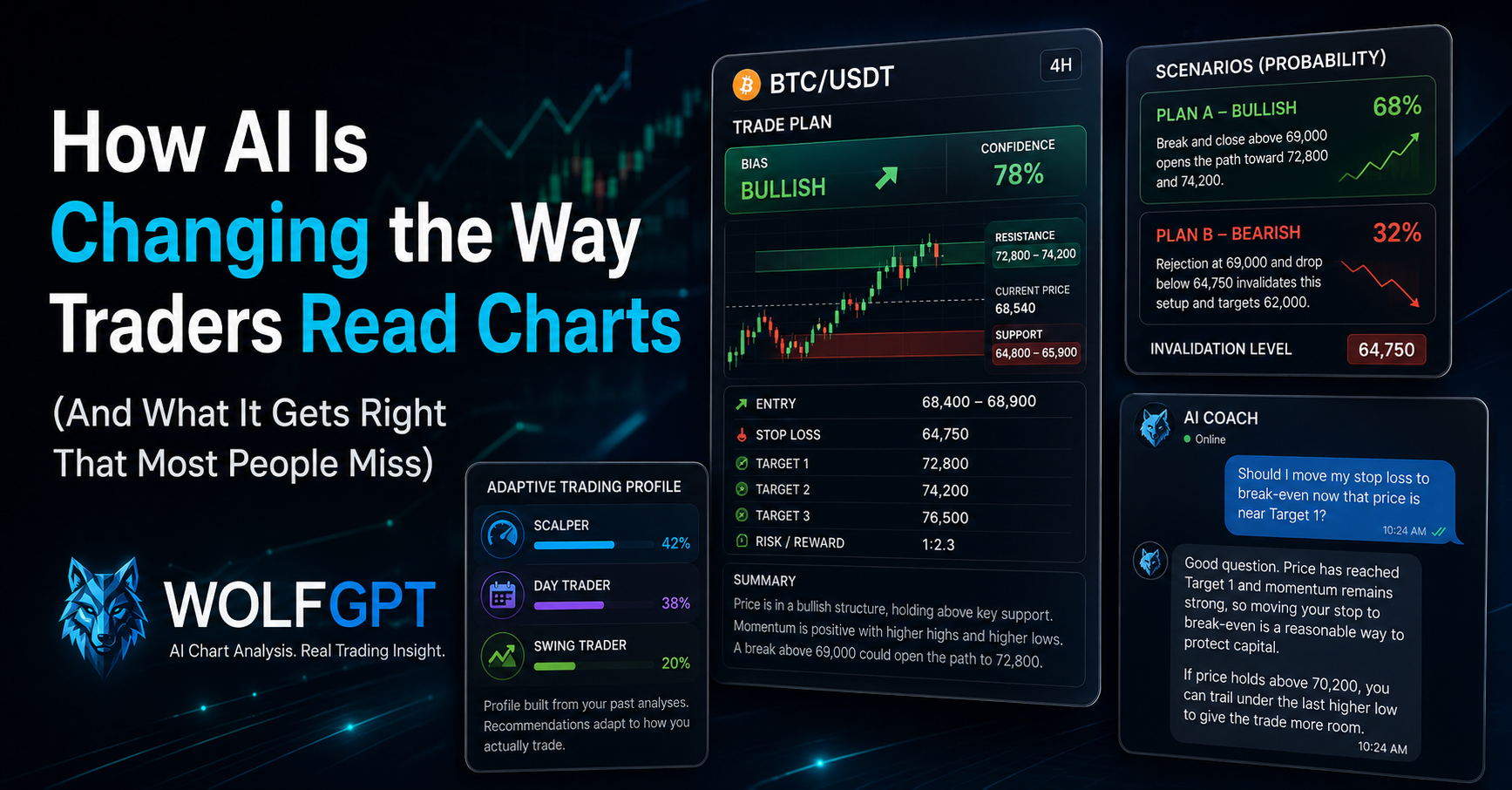
Reading a price chart well is one of those skills that looks simple from the outside and takes years to actually build. Two people can stare at the exact same chart and walk away with completely different conclusions, not because one of them is guessing and the other isn’t, but because pattern recognition in trading is mostly built through repetition. You see enough setups play out, enough times, before the structure starts to jump out at you instead of requiring conscious effort.
That’s exactly the kind of skill AI tends to be good at compressing. Not by replacing judgment, but by doing the pattern-matching faster than a human can, and explaining what it found in language a beginner can actually use.
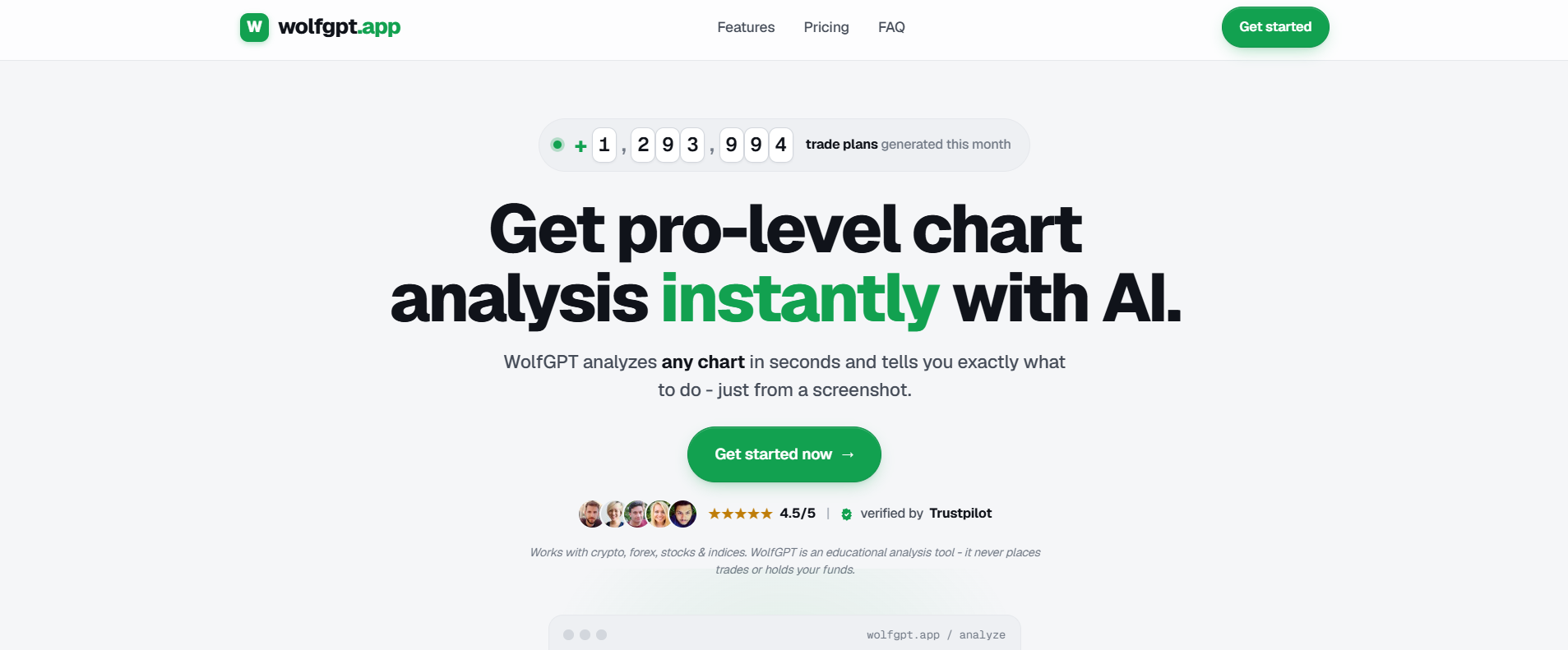
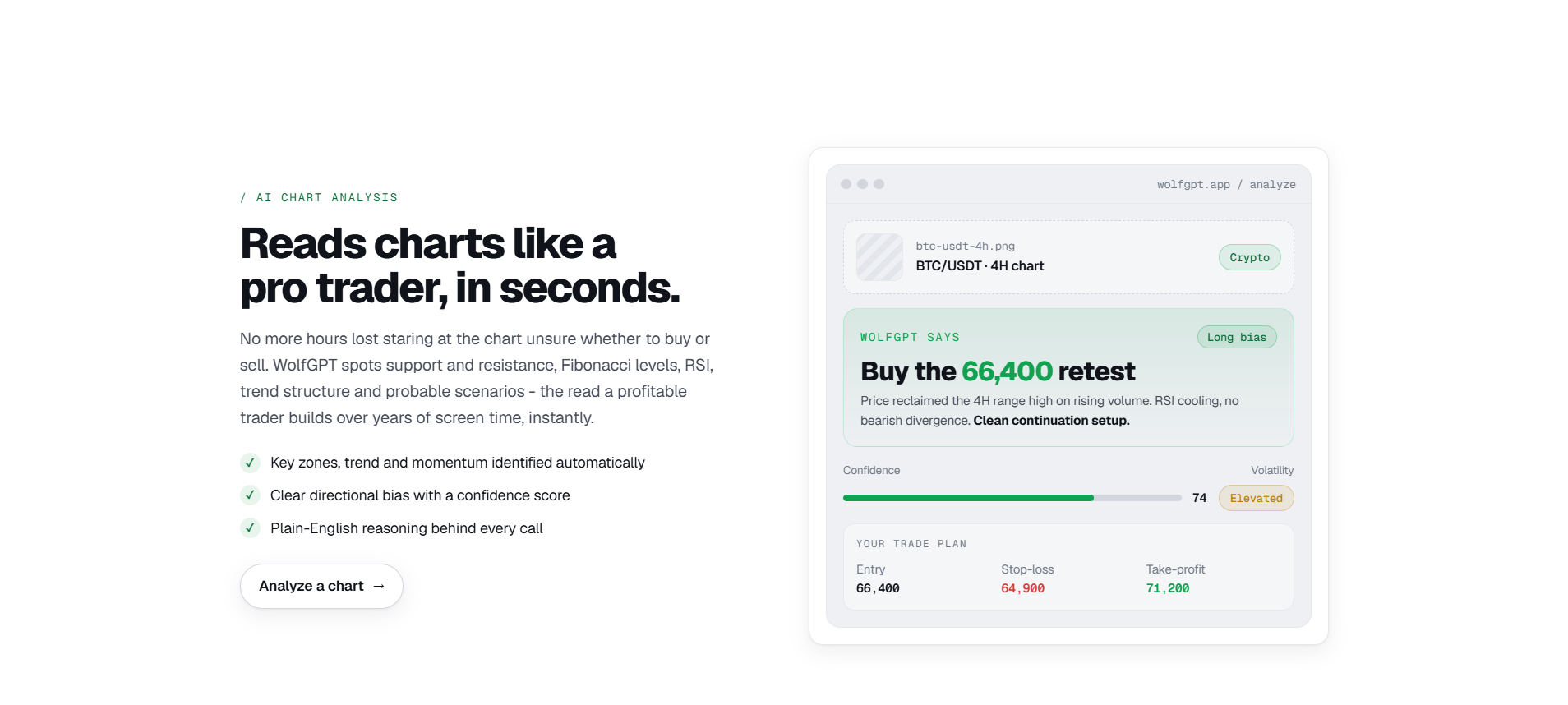
WolfGPT is a useful case study here, because it’s built around one narrow job: you upload a screenshot of a chart, and it returns a full read, including the trend structure, key support and resistance zones, momentum signals, and a plain-English explanation of what it’s seeing. It’s worth breaking down not because it’s flashy, but because of what it gets right about how people actually struggle with charts.
The real problem isn’t a lack of information
Most new traders aren’t short on information. Free charting tools show every indicator imaginable, RSI, moving averages, Fibonacci levels, volume profiles. The problem is rarely “I don’t have enough data.” It’s “I don’t know how to weigh all of this against itself in real time.”
That’s a synthesis problem, not a data problem, and it’s where a lot of self-taught traders get stuck for months or years longer than necessary. They can name the indicators. They just can’t yet combine five conflicting signals into one coherent read with any confidence.
This is the gap WolfGPT is built to close. Instead of returning more raw data, it returns a synthesized read, similar to what a profitable trader builds after years of screen time, by identifying key zones, trend direction, and momentum automatically, then explaining the reasoning behind the call rather than just outputting a verdict.
Why a stated confidence score matters more than it sounds
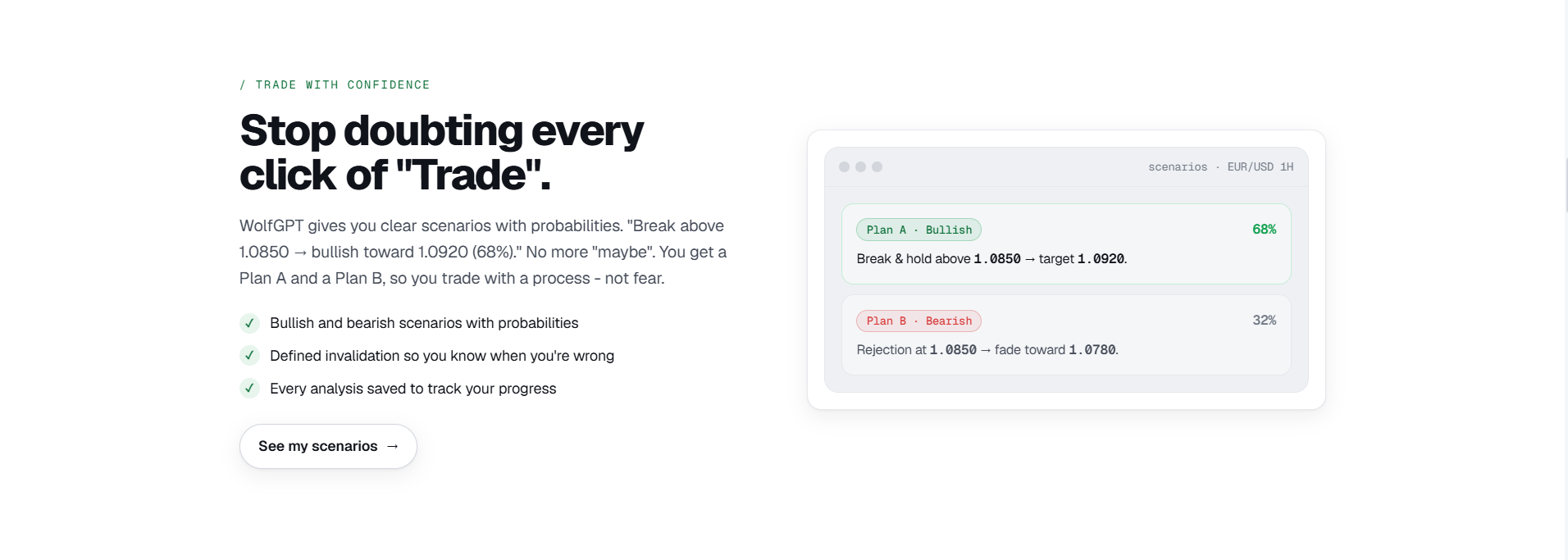
One detail worth paying attention to is that WolfGPT doesn’t just say “bullish” or “bearish.” It attaches a confidence level and lays out scenarios with probabilities attached, something closer to “break above this level leans bullish toward this target, with this level invalidating the read.”
That structure matters for a reason that’s easy to underestimate: it gives a trader something to act on and something to be wrong about. A flat directional call with no nuance leaves no room to plan for the scenario where the market does the opposite. A probability-weighted scenario with a clear invalidation point does. That’s closer to how experienced traders actually think, in terms of “if this happens, I do this; if that happens, I do that,” rather than a single confident guess.
For beginners specifically, this also teaches the right habit early. New traders often learn to chase certainty that doesn’t exist in markets. Tools that present probabilities instead of absolutes are quietly training people to think in terms of risk and scenarios from day one, which is a healthier foundation than learning to expect a clean yes-or-no answer every time.
The adaptive piece is what separates this from a one-size-fits-all tool
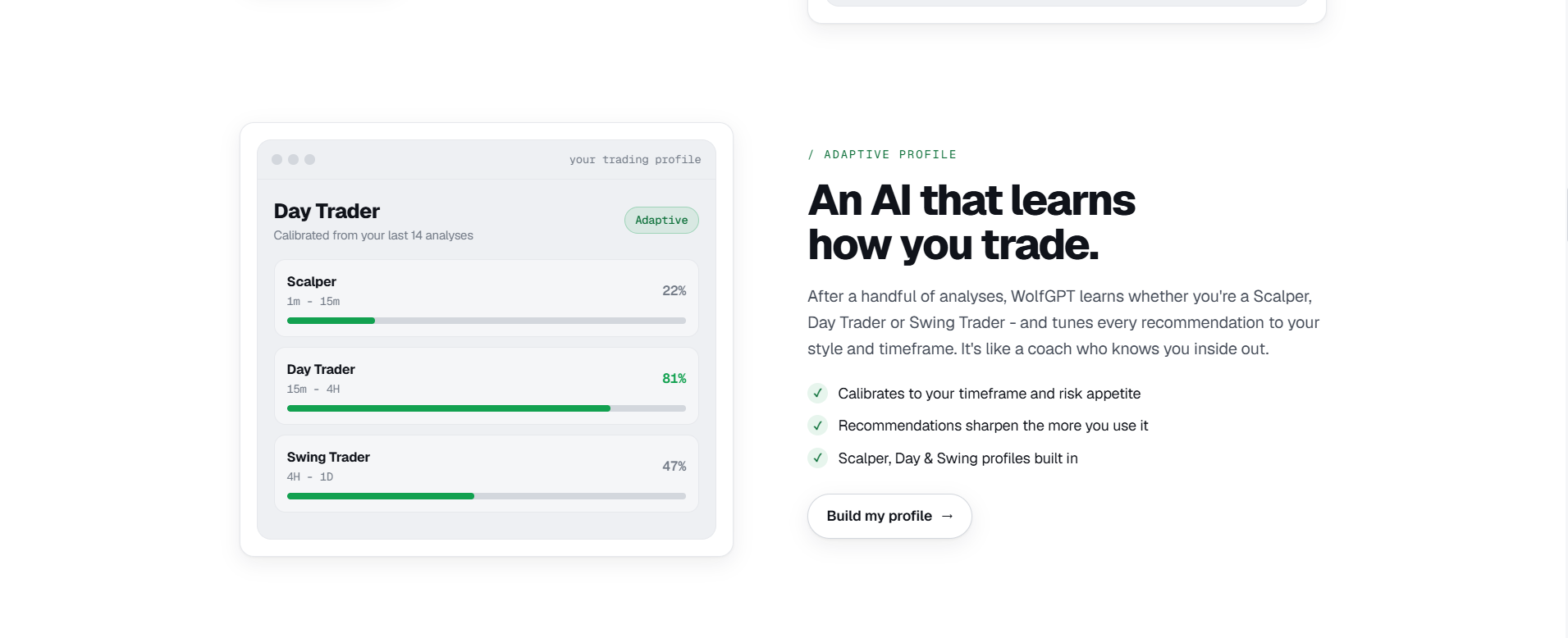
The other detail worth calling out is that WolfGPT adjusts based on how someone actually trades. After enough analyses, it picks up on whether a person trades like a scalper, a day trader, or a swing trader, and tunes its recommendations to that timeframe and risk profile.
This matters because a scalper and a swing trader can look at the identical chart and have completely different correct answers. A five-minute reversal that’s noise to a swing trader is the entire trade for a scalper. A generic tool that gives the same read to everyone regardless of their actual trading style isn’t really solving the problem, it’s just producing a single static answer and hoping it happens to fit. Calibrating to the person using it, rather than treating every user identically, is a meaningfully different design decision, and it’s the kind of detail that tends to separate tools people use once out of curiosity from tools people keep coming back to.
What this looks like in practice
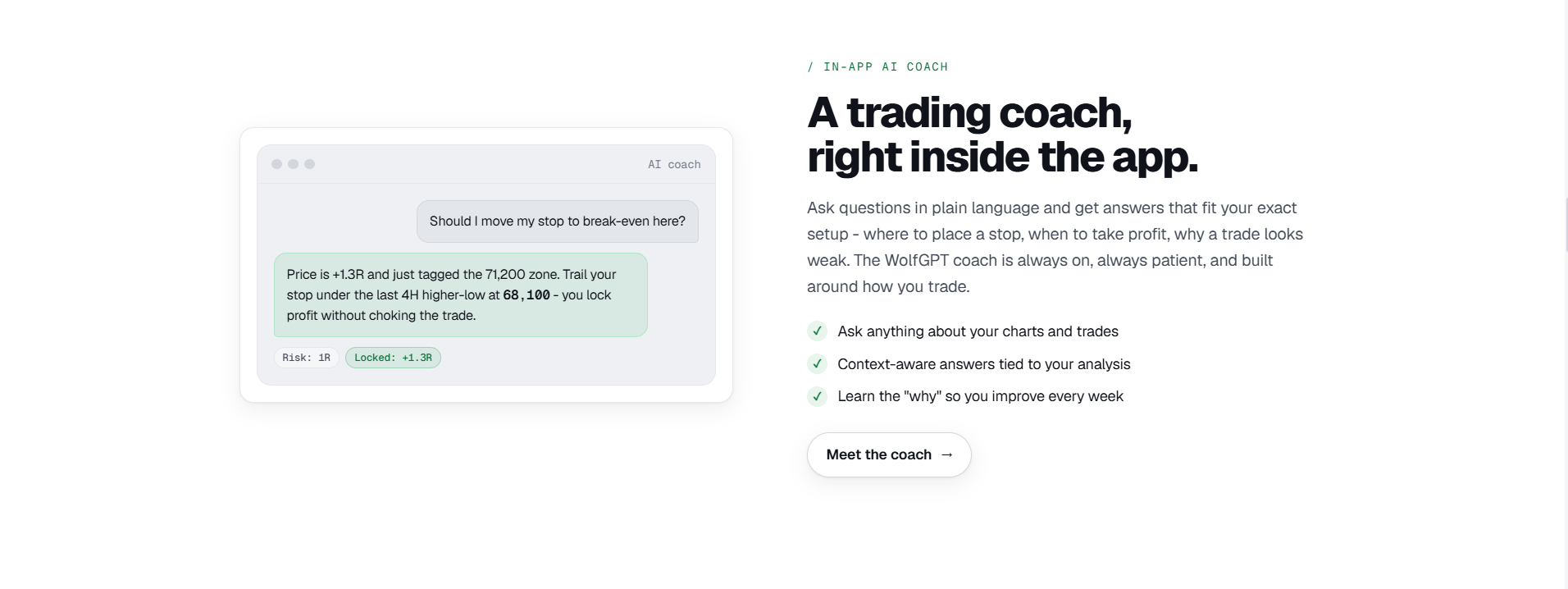
The mechanics are simple enough to describe in three steps: upload a chart screenshot from any platform, covering crypto, forex, stocks, or indices, get back a structured read of zones, trend, and momentum within seconds, and from there ask follow-up questions to an in-app coach about specific decisions, like where a stop-loss makes sense or why a particular setup looks weak.
The “ask a follow-up” piece is arguably the most underrated part of how a tool like this should be evaluated. A static output that gets handed over once and can’t be questioned is much less useful than one that lets a person dig into the reasoning until it actually makes sense to them. Learning happens in that back-and-forth, not in the first answer.
Where the limits actually are
None of this means a chart-reading AI removes the need for judgment, and it’s worth being direct about that. WolfGPT, like any tool in this category, is explicit that it’s an educational analysis tool, not financial advice, and it doesn’t place trades or guarantee outcomes. Markets are probabilistic by nature, and no read, human or AI, gets it right every time.
The realistic way to think about a tool like this is as a second opinion delivered at the exact moment a trader would otherwise be staring at a chart, unsure whether their own read is correct. That’s a meaningfully smaller and more honest claim than “this will make you profitable,” and it’s also the more useful one. A second opinion that’s wrong occasionally is still valuable if it’s consistently helping someone reason through a decision instead of freezing on it.
The bigger pattern this fits into
Strip away the trading context for a second, and this is really a story about what good AI tooling looks like when it’s built around one specific, well-understood problem instead of trying to be everything to everyone. Identify the actual bottleneck, in this case synthesis and confidence rather than raw data, design around that specific gap, and stay honest about what the tool can and can’t promise.
That’s a useful checklist regardless of the category. Whether the skill being compressed is reading a chart, writing in a brand’s voice, or debugging code, the tools that hold up over time tend to be the ones built around a single, well-defined problem rather than a long list of features. WolfGPT is a clean example of that approach applied to one of the harder skills to learn by trial and error alone.
Trading involves significant risk of loss, and tools like the one discussed here are educational in nature rather than a substitute for independent research or financial advice.
Join Writecream for FREE!
In just a few clicks and under 30 seconds, generate cold emails, blog articles, LinkedIn messages, YouTube videos, and more.
It's free, forever!
Leave A Comment
Join Writecream for FREE!
In a few clicks and under 30 seconds, generate cold emails, blog articles, LinkedIn messages, YouTube videos, and more — no credit card required.
Start for FREE