Introduction
Creating content that ranks on Google is not only about choosing the right keyword — it is also about how well your content is structured and presented. Headings, keyword placement, and overall content flow play a crucial role in helping search engines understand your page and helping users navigate it easily. Even valuable content can struggle to perform if headings are misused, keywords are poorly placed, or the structure feels confusing.
Headings such as H1, H2, and H3 define the hierarchy of your content. Keywords connect your content with user search intent. Content structure ensures that information flows logically from introduction to conclusion. When these three elements work together, your content becomes easier to crawl, easier to read, and more likely to rank.
With the Lexi AI Agent inside the Writecream SEO Editor, optimizing headings, keywords, and structure becomes a guided and data-driven process. Instead of manually fixing heading issues or guessing keyword placement, Lexi AI analyzes top-ranking pages and provides clear suggestions to help you build well-structured, SEO-friendly content that aligns with Google’s expectations.
Why Optimizing Headings, Keywords & Content Structure Is Important
Search engines rely on structure and context to evaluate content quality. Proper heading hierarchy helps Google understand which topics are most important on your page, while keywords signal relevance to search queries. A clear content structure improves readability, keeps users engaged, and reduces bounce rate.
Optimized headings allow search engines to interpret your content sections accurately. Strategic keyword placement ensures that your page matches relevant searches without appearing spammy. A strong structure improves user experience, making it easier for readers to scan, understand, and trust your content. Together, these factors directly influence rankings, click-through rates, and overall SEO performance.
When Should You Optimize Headings, Keywords & Structure?
You should focus on optimizing headings, keywords, and content structure in several key situations. This includes before publishing any new blog or article, when updating old content that is not performing well, or when targeting competitive keywords where structure plays a major role. It is also essential when creating long-form content, guides, or landing pages that require clear organization to satisfy both users and search engines.
Step-by-Step Guide: How to Optimize Content Using Lexi AI
Step 1: Open the Writecream SEO Editor
To begin optimizing your headings, keywords, and content structure, you first need to access the Writecream SEO Editor from your account.
Follow these steps:
Log in to your Writecream dashboard, navigate to the SEO Tools section, and open the Lexi AI Agent & SEO Editor using the link below:
👉 https://app.writecream.com/seo-query
Once the editor opens, you will see the writing interface along with SEO analysis panels. At this stage, your goal is not to publish content immediately, but to prepare your article for proper structural optimization using Lexi AI’s insights.

Step 2: How Lexi AI Agent Supports Structural Optimization
Before you start editing or writing, it is important to understand how Lexi AI assists with content structure. Lexi AI works as an SEO optimization assistant that studies top-ranking pages and identifies how successful content is organized.
Lexi AI helps you by analyzing heading hierarchy, keyword placement, content flow, and section relevance. It identifies whether your headings follow proper H1–H3 order, checks if keywords are placed naturally and ensures your content structure aligns with search intent. Instead of manually reviewing competitor articles, Lexi AI presents all optimization insights directly inside the editor.

Step 3: Optimizing the H1 Heading
The H1 heading represents the main topic of your page and should clearly communicate what the content is about. Lexi AI evaluates whether your H1 includes the primary keyword naturally and matches user intent.
At this step, Lexi AI ensures that only one H1 is used, that it reflects the core topic accurately, and that it aligns with how top-ranking pages phrase their main titles. A well-optimized H1 sets the foundation for both search engines and readers.
Step 4: Structuring H2 and H3 Headings
Once the H1 is optimized, Lexi AI guides you in organizing H2 and H3 headings properly. H2 headings divide the content into major sections, while H3 headings break those sections into detailed subtopics.
Lexi AI studies competitor structures and suggests relevant sections that users expect to see. It helps ensure that headings follow a logical flow, avoid repetition, and cover all important subtopics. This improves both crawlability and readability, making your content easier to scan and understand.
Step 5: Keyword Placement Within Headings and Content
After structuring headings, Lexi AI focuses on keyword optimization. Instead of keyword stuffing, the tool ensures that keywords are placed naturally within headings, introductory paragraphs, body content, and conclusions.
Lexi AI identifies related keywords, semantic terms, and variations based on real search data. These suggestions help strengthen topical relevance while keeping the content natural and user-friendly. The editor continuously monitors keyword usage to maintain balance and avoid over-optimization.
Step 6: Improving Overall Content Structure and Flow
Content structure is not just about headings — it is also about how ideas are presented and connected. Lexi AI evaluates paragraph length, section transitions, and content order to ensure smooth readability.
By comparing your content with top-performing pages, Lexi AI suggests structural improvements that align with user expectations. This helps ensure that your content answers questions in the right sequence and delivers information clearly and effectively.
Step 7: Real-Time Optimization and SEO Score Updates
As you optimize headings, keywords, and structure, the SEO score inside the editor updates in real time. This allows you to track improvements instantly and identify areas that need further refinement.
Lexi AI highlights structural issues, keyword gaps, or heading inconsistencies and provides actionable suggestions. This real-time feedback ensures that your content is fully optimized before publishing.
Understanding the SEO Editor Layout
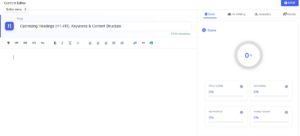
Once inside the SEO Editor, you will notice multiple sections designed to guide your optimization process. The Editor Area allows you to write and edit content freely. The SEO Score Panel displays how well your content is optimized. The Analysis Tabs provide insights into headings, keywords, and structure, while the Suggestions Panel offers real-time improvement tips based on competitor data.
All sections update automatically as you make changes, allowing you to optimize efficiently without switching tools.
Tips for Best Results
-
Maintain a clear and logical heading hierarchy from H1 to H3.
-
Ensure your headings clearly reflect user search intent.
-
Write naturally and focus on clarity instead of forcing keywords.
-
Use Lexi AI’s suggestions as guidance, not strict rules.
-
Review your content thoroughly before publishing for quality and accuracy.
Mistakes to Avoid
-
Using multiple H1 headings on a single page.
-
Placing keywords unnaturally within headings or content.
-
Ignoring proper heading hierarchy and content structure.
-
Creating long paragraphs without clear breaks.
-
Focusing only on SEO scores while neglecting readability and user value.
Conclusion
Optimizing headings (H1–H3), keywords, and content structure is essential for creating content that performs well in search results. These elements help search engines understand your content and help users navigate it effortlessly.
With the Lexi AI Agent inside the Writecream SEO Editor, this process becomes structured, data-driven, and easy to follow. Instead of guessing what works, you can rely on real insights to create well-organized, SEO-friendly content that ranks and engages.
Start Now
Try the Writecream SEO Editor today:
👉 https://app.writecream.com/seo-query
Optimize your headings, structure your content, and improve your SEO performance with confidence 🚀