Search Engine Optimisation (SEO) is generally referred to as consisting of three major aspects: Technical SEO, On-Page SEO, and Off-Page SEO. Technical SEO and On-Page SEO are more related to search engines being able to understand your website and rank it properly, while the other focuses on Backlinks and others.
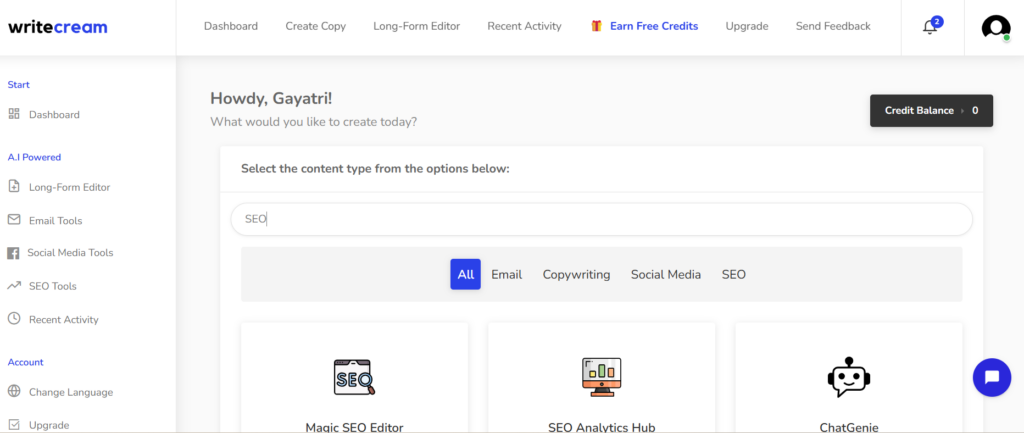
The problem is that even the best-written news stories can fail to rank if there are issues on the technical front or if the on-page factors are not optimised. This is where the importance of a technical SEO audit and on-page optimisation comes into the picture. This can now be done more effectively using tools like the SEO Editor on Writecream’s AI agent Lexi AI.
In this article, I will guide you on some of the key technical aspects of SEO that you should focus on to improve your website.
Understanding Technical SEO
Technical SEO is basically the optimisation of the infrastructure level of a website so that the search engines can efficiently crawl, index, and rank the pages on the website. It is not concerned with content creativity but with other aspects.
A technically well-built website ensures:
- The website
- Quick page loading
- Increased crawlability
- Mobile compatibility
- Secure browsing
- Vertical bar
If these fundamentals are not in place, search engine optimisation will never work by itself.
Core Web Vitals and Their Role in Technical SEO
Core Web Vitals are a set of metrics related to performance that were indicated by Google in order to measure real-world user experience on a website. It speaks to how fast a page loads, how quickly it’s able to get interactive, and how stable the layout remains during loading.
These are Largest Contentful Paint, First Input Delay, and Cumulative Layout Shift, important Core Web Vitals. Optimising these metrics enhances page speed, reduces layout shift, and increases usability. Meeting thresholds for Core Web Vitals increases the probability of better search rankings and longer user retention for a website.
Structured Data and Schema Markup
Structured data helps search engines understand the context beyond plain text. Heavily using a schema markup qualifies your website to show up in the rich results section, which includes featured snippets, FAQs, ratings, and breadcrumbs.
Structured data in place enhances search appearance and click-through rates, without necessarily having to improve rankings. This also reduces the ambiguity for search engines, making the content more understandable to interpret and classify correctly.
Duplicate Content and Canonicalisation
Content duplication is when similar or identical content exists on the web under different URLs. This will surely mislead the search engines and dilute the ranking signals.
Using canonical tags helps to state which is the preferred version of a page by putting all SEO value together. Proper canonicalization means that appropriate pages are indexed by the search engines and thus inhibit useless competition between similar URLs.
Optimising for Search Intent Alignment
Search intent is the motive behind a user’s query. Pages that do not match intent are hard to rank, despite any technical or on-page optimisation.
More precisely, understanding whether the intent is informational, navigational, commercial, or transactional, it allows the structuring of the content in that particular direction. Headings, examples, and CTAs match better for the intent, thus giving relevance and satisfaction.
Advanced Technical SEO: Log File Analysis
Log file analysis helps understand how search engine bots interact with your website. This gives insight into which pages are most crawled and where there could be wasted crawl budget.
This insight allows for the optimisation of internal links, the removal of crawl traps, and the prioritisation of important pages. While more advanced, log file analysis offers very valuable data for large or growing websites.
Essential Technical SEO Checks
1. The Crawl
Web crawlers are used by search engines to crawl your site. If the crawlers can’t access your site’s web pages, your site’s contents won’t be visible in search engine results.
Primary checks are:
- Ensure important pages are not blocked by robots.txt
- Preventing Unnecessary Noindex Tags
- Ensuring a clean internal linking structure
This makes it easier for the search engines to interpret the relationships between the pages.
2. Indexing Status
Indexing makes sure your pages are accommodated within search engine databases. Pages that are crawled but not indexed will rank nowhere.
Checks on indexing, important :
- Pages should return a 200 status code
- Avoid duplicate URLs with different parameters
- Use canonical tags correctly
- Update the XML sitemap submitted
Indexing issues usually are caused by duplicate content, thin pages, or improper usage of tags.
3. Page Speed and Performance
Page speed is a confirmed ranking factor and directly influences user experience. Slow websites lead to higher bounce rates and lower engagement.
Key performance areas:
- Optimised images
- Minified CSS and JavaScript
- Reduced server response time
- Browser caching
Pages that load fast maintain user interest and improve the overall performance of their SEO.
4. Mobile
Google operates a mobile-first index, whereby Google first analyses the mobile version of a website.
Mobile optimisation checks:
- Responsive design
- Legible font sizes
- Clickable buttons & links
- There is no horizontal scrolling
Having a mobile-friendly site provides uniformity and ensures a high ranking.
5. HTTPS and Website Security
Security is both a trust and a ranking factor. Sites that use HTTPS are given priority over sites that use the non-secure version, HTTP.
Technical security checks:
- Valid SSL certificate
- No mixed content issues
An SSL site enhances credibility for both visitors and search engines.
6. URL Structure Optimisation
Best practices:
Short and readable URLs
Well-structured URLs help in better crawling and click-through rates.
7. XML Sitemap and Robots.txt
Sitemap submitted to search engines
Only valuable pages included
These files serve as communication channels between your website and search engines.
On-Page SEO Factors Explained
On-page SEO is all about optimising individual web pages. It is the area where technical implementation meets content quality.
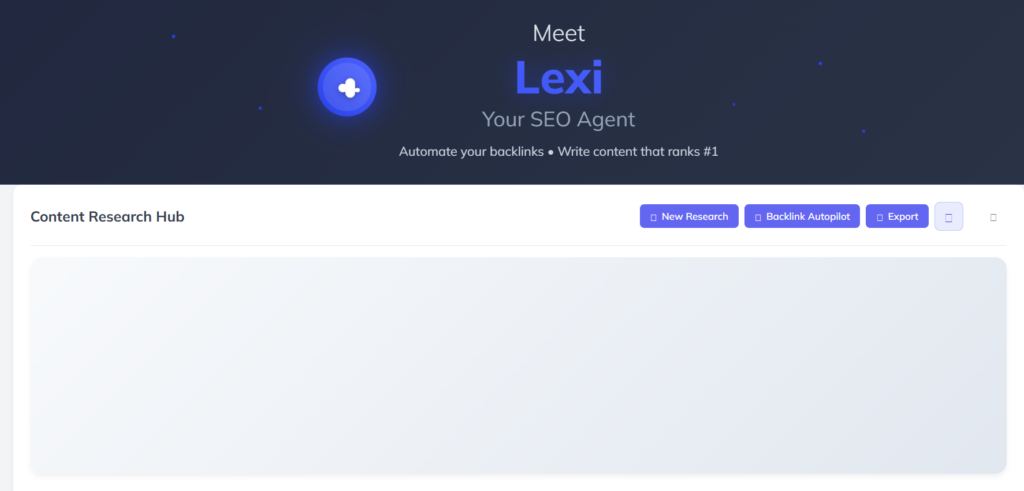
Key On-Page Elements to Optimise in Lexi AI
1. Title Tags
Title tags are some of the strongest on-page ranking signals. They also have an impact on click-through rates from search engine result pages.
Best Practices
- Keep titles within the recommended length
- Include the target keyword naturally
- Make them compelling and clear.
- Avoid duplication across pages
A well-composed title sets users’ expectations and enhances visibility.
2. Meta Descriptions
While not a direct ranking factor, meta descriptions have a great influence on clicks.
Optimisation tips:
- Summarise the content on the page using your own words.
- Use action-oriented language
- Only include target keywords naturally.
- Keep appropriate length
A robust meta description bolsters engagement from search results.
3. Headings Hierarchy (H1 – H6)
Headings do help the search engines understand the hierarchy of content; moreover, it improves readability for users.
Usage:
- One easy-to-read H1 per page
- H3 – Logical flow from H2
- Include keywords where relevant
- Avoid over-optimisation
It makes the content skimmable with clear headings, and it also complements SEO.
4. Quality and Relevance of Content
Quality content remains the core of on-page SEO. The search engines give priority to content that satisfies user intent.
Effective content should:
- Address the search intent clearly
- Cover subtopics in-depth.
- Avoid keyword spamming or keyword stuffing.
- Value, not fluff.
I usually use a supporting assistant like Writecream’s Lexi AI to ensure originality and clarity.
5. Keyword Placement
Keyword usage must be natural and serve a purpose.
Best placement areas:
- Title tag
- Meta Description
- Headings
- First 100 words
- Image alt text
Overuse hurts readability and can cause penalties, while strategic placement enhances relevance.
6. Internal Linking
Internal linking can help spread link equity across the site and will take users through related content.
Best Practices :
- Link to relevant pages
- Use descriptive anchor text
- Avoid linking unnecessarily
- Logical navigation is maintained.
Strong internal linking improves crawlability, and it also develops user engagement.
7. Image Optimisation
Images improve content, but slow down pages if their sizes are not optimised.
Image SEO checks:
- Descriptive filenames
- Alt text for accessibility
- Compressed file sizes
- Proper formats
Optimised images allow for performance and visibility in image search results.
8. URL and Slug Optimisation
Page slugs should reflect content focus.
Tips:
- Keep URLs concise
- Eliminate unnecessary words.
- Page intent match
- Avoid dynamic strings
A clean slug is both more readable and provides more ranking potential.
Technical SEO and On-Page SEO: How They Work in Tandem
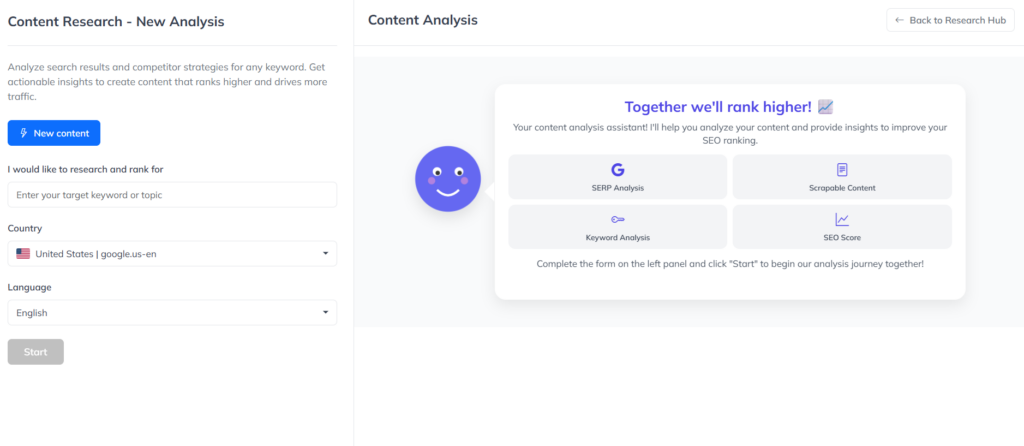
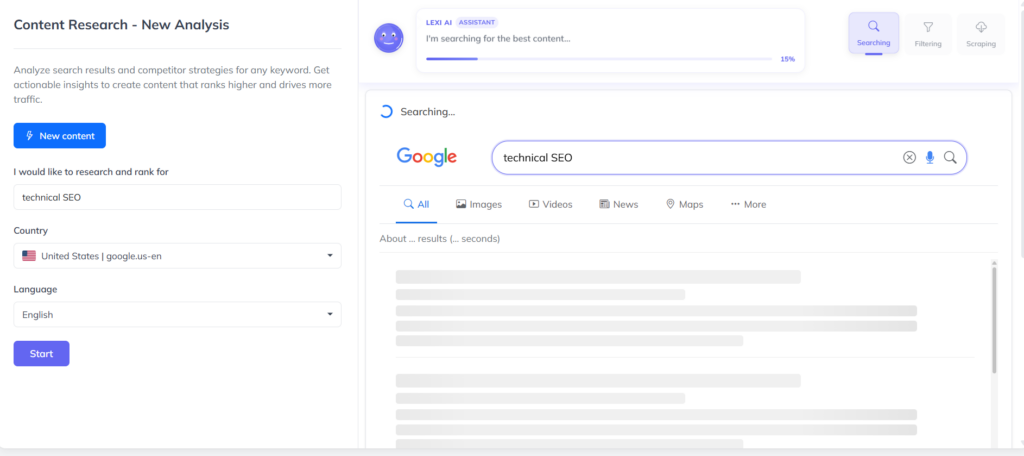
Technical SEO ensures that search engines can crawl and understand your site, while on-page SEO makes sure they know what each page is about.
Without technical optimisation of:
- Pages may not index
- Content may load slowly
- Mobile users might not be able to do this.
Without on-page optimisation:
- Content may be irrelevant
- The pages may not rank for target queries.
- User engagement can decrease.
- Together, they make a powerful SEO foundation.
- Using Writecream’s SEO Editor for Technical & On-Page Checks
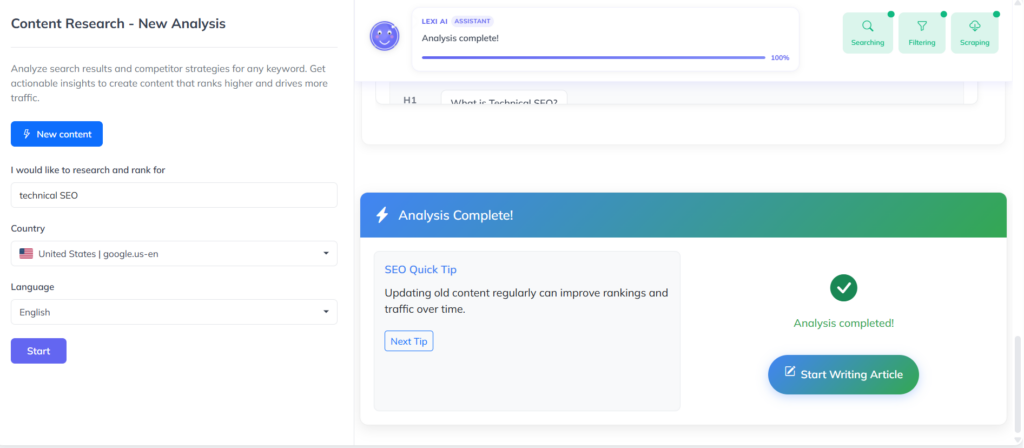
The dashboard of Writecream simplifies SEO optimisation by:
- Highlighting of missing on-page elements
- Guiding content structure improvements
- Keyword placement assistance
- Improving readability and flow.
While AI tools can ease the process, human review and intent alignment are not to be forgotten when considering effective SEO writing.
Common Mistakes to Avoid in Technical SEO
- Accidentally blocking important pages
- Ignoring mobile optimisation
- Overlooking page speed issues
- Duplicates also make use of metadata created and applied by a previous system, including and especially those recorded within the JPEG.
Small technical mistakes, if not corrected, can make huge differences in rankings.
Common SEO Mistakes to Avoid On-Page
- Keyword spamming
- Missing or duplicate title tags
- Poor heading structure
- Thin or low-value content
By avoiding these mistakes, one not only enhances search performance but also the user experience.
Conclusion
Technical SEO checks and on-page elements are never one-time processes; they are ongoing optimisation tasks. Search engines keep on developing and changing, user behaviour keeps changing, and websites keep growing-it’s an ongoing monitoring task.
By simply combining:
- Strong technical foundations
- Well-structured on-page elements
- High-quality, intent-focused content
This is because you build a site that the search engines can trust and your users appreciate.
SEO, on the other hand, with the use of tools such as Writecream’s SEO Editor and Lexi AI, works out to be more feasible, organised, and yielding when guided by human experience and creativity.