Every inbox feels crowded these days. Your subject line gets one second, maybe two, to earn attention.
At the same time, spam filters are sharper than ever. They no longer scan for single “bad words.” They score intent, tone, and trust. No matter how strong your email is, if it feels generic or sales-heavy, it’ll never hit the inbox.
After years of testing subject lines across different industries, I’ve learned that the ones that consistently beat spam filters share the same traits: Specificity, intention, and value.
Let’s take a closer look at Subject Line Writing Tips and what makes subject lines click-worthy, and what sends them straight to spam jail. 👇
What Spam Filters Are Looking For (And Why It Matters)
Spam filters don’t work off a static list of banned words anymore.
As Gmail confirms, spam filters rely on machine learning powered by user feedback to decide what goes to the inbox and what gets filtered out. The system adapts continuously based on how people interact with emails.
Here’s what spam filters analyze to decide whether to send your email to an inbox …
- Language patterns: Does your subject line feel either vague or emotionally inflated? Spam filters interpret it as a signal of low trust and higher risk.
- Behavior signals: Do recipients consistently delete your emails without opening, ignore them, or mark them as spam? Filters treat those actions as feedback that you’re not a reliable sender.
- Sender reputation: Does your domain or IP have a history of complaints, high bounce rates, or missing authentication (SPF, DKIM, DMARC)? Spam filters are more likely to divert your emails away from your inboxes.
- Message alignment: Does your subject line promise one thing, yet the email body delivers something different? The system flags this mismatch as deceptive, which reduces your email delivery rate over time.
Google explains it this way…
“Gmail employs a number of AI-driven filters that determine what gets marked as spam. These filters look at signals such as the characteristics of the IP address, domains, bulk sender authentication, and user input. User feedback — such as when someone marks an email as spam or chooses to keep it in their inbox — trains the filtering system.”
In other words, your subject line also affects your sender reputation footprint. (And if you’re showing spam filters that you’re untrustworthy, they’ll send you straight to the junk folder.)
Subject lines can also make or break your email campaigns, since they influence whether someone opens your email, archives it, or reports it as spam.
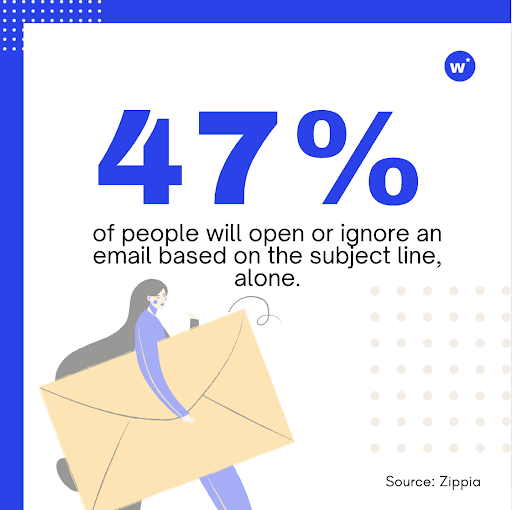
In fact, Zippia found that for 47% of people, the subject line is the only important factor in whether they’ll open an email or not. And 69% will mark an email as spam if its subject line gives off the wrong vibe.
So, your subject line impacts two outcomes at once: whether a real person wants to open your message and whether inboxes continue to trust your domain in the long term.
9 Tips for Subject Lines That Consistently Avoid Spam Filters
Strong subject lines don’t rely on tricks or exaggerated language.
They work because they communicate value quickly and clearly, while reinforcing your sender reputation over time.
Each tip below focuses on one practical shift that improves both human engagement and filter trust signals, so your emails get noticed and delivered. 👇
1. Keep Subject Lines Short Enough to Scan
Most people read subject lines on their phone. If the line doesn’t fit, the meaning gets lost and the email becomes too much mental effort. The inbox is a glance environment, not a library.
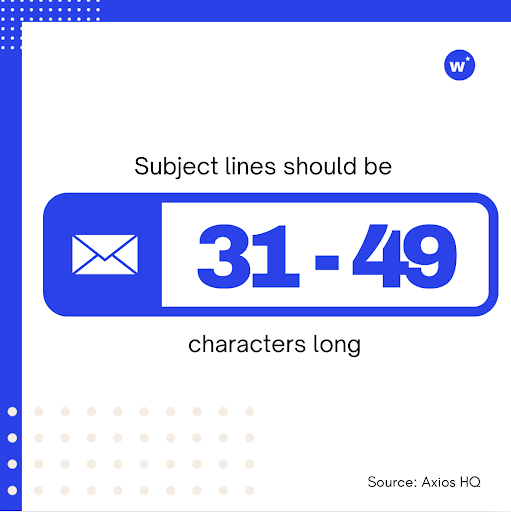
According to Axios HQ’s study of 69,000+ subject lines, best performers are 31–49 characters, or 3–6 words.
Short, clear phrasing helps the reader understand the message instantly, which improves both engagement and deliverability.
For example, look at these subject lines from permies.com:
- “plotskateers – help create the eBook Per…”
- “AI v Permaculture; growing a roof; 2×4 s…”
- “maple syrup reached – an earthbag hous…”
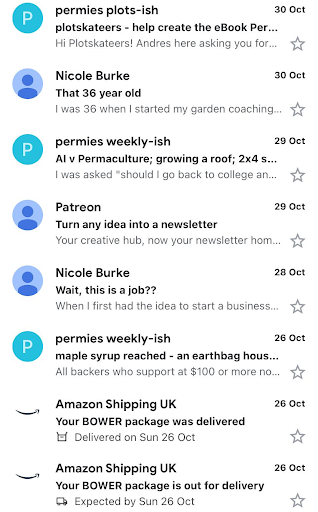
While the emails are full of interesting content, the message isn’t clear at a glance. The value is buried.
Now watch what happens when we trim to the essential idea:
- “Help Shape the New eBook”
- “AI vs Permaculture: Your Take?”
- “We Reached the Maple Syrup Goal”
Each line now fits on a phone screen and respects the reader’s attention rather than competing for it.
2. Lead With Specificity Instead of Hype
When your email marketing subject line states exactly what the reader will see, the message feels credible. Hype, on the other hand, signals manipulation.
As much as humans don’t like trickery, neither do spam filters. Spam filters look for inflated tone, not just certain trigger words. So rather than hinting at value, name it.
A simple structure that works well for this is: Material or Feature + Product + Emotional Benefit.
For example, say you’re sending an email about a new Seersucker suit collection, you might use a subject line like…
“Italian Seersucker Suits: Timeless Style”
Italian = Feature
Seersucker = Material
Suits = Product
Timeless Style = Emotional benefit
Notice how there’s no action verb at the beginning, either?
It’s tempting to write something like “See Our New Seersucker Suit” or “Shop the Seersucker Drop.” (But this can come off as salesy, which signals distrust.)
Instead, your subject line should read like a confident recommendation, not a pushy pitch. When you do this, it signals credibility to readers and to spam filters, which improves both trust and your deliverability rate.
3. Match Your Subject Line to the Email Body
Spam filters check whether the subject line matches the actual content of the email. If the subject promises one thing and the body delivers something else, the system flags the message as untrustworthy.
The same applies when tone and intent don’t align. This matters even more in emotionally sensitive contexts, where the reader needs to feel safe and respected.
For example, imagine you’re sharing a supportive resource about teenage depression treatment.
You use a subject line like …
“New Program Announcement + Big Update Inside”
However, this doesn’t accurately reflect the content of the email. It sounds administrative and promotional, while the email itself may be personal and supportive.
The mismatch creates confusion for the reader. As a result, spam filters read that disconnect as a trust issue.
Now compare that to a subject line like this:
“10 things to say to someone with depression”

This line aligns with the content inside. It signals the topic, tone, and purpose while preparing the reader emotionally. And because the subject and the message match, filters treat the email as credible, not manipulative.
4. Use Curiosity, Not Clickbait
Curiosity works when it gives the reader something real to lean toward.
Clickbait, on the other hand, attempts to capture attention by hinting at answers it refuses to reveal. Human readers and spam filters recognize and penalize this kind of gimmick.
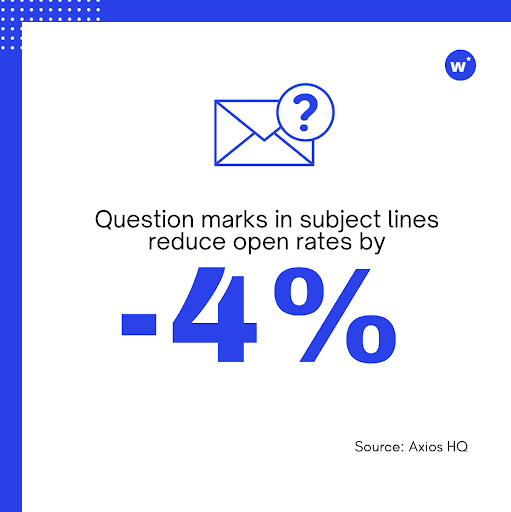
One tangible pattern that makes subject lines feel like clickbait is using a question mark. A question mark often reads like a hook without substance, which can feel evasive or over-engineered. According to Axios HQ, using question marks can decrease open rates by approximately 4 percentage points.
Here’s an example in action.
Imagine a Beaches of Normandy tour guide operator is sending an email.
A clickbait version might look like this:
“Guess what happened on D-Day?”
This subject line withholds information. It performs a mystery without offering value. (It tries to pull attention instead of earning it.)
Now compare that to a curiosity-driven subject line that states something unexpected directly:
“The WWII moment that almost ended British cheesemaking”

There’s no tease. No forced intrigue. It shares something surprising and specific, tied to the content inside the email. The reader leans in because the line itself has value.
The key is to reveal something, not conceal it. Present one interesting detail clearly, and let the reader decide to learn more.
5. Rephrase Trigger Words Instead of Removing Value
Filters don’t block single words. They block tone patterns that suggest pushiness.
So instead of removing words like “free” or “exclusive,” rewrite them with grounded language. This keeps the meaning while removing the hype.
For instance, instead of “Get Free Access Now,” try “Unlock complimentary access today.”
The offer stays intact, but the tone shifts into something calmer and more trustworthy.
And if you’re unsure how to rephrase something, try using a paraphrasing tool to refine the language while keeping the message the same.
6. Personalize Beyond the First Name
Email personalization works, and the data confirms it.
As Litmus’ 2024 State of Email Trends report found, 77% of email marketers say subject line personalization improves performance. And according to Zippia, personalized subject lines for email campaigns can increase open rates by up to 50%.
But personalization works best when it reflects context, not solely identity.
In other words, you want to personalize more than just the reader’s first name. To truly show your readers you know and value their needs, try referencing their behavior, timeline, or interests.
For example, try subject lines like:
- “Continue your research on Mediterranean design.”
- “Don’t miss out on the party dress in your cart.”
- “Here’s the session you paused last week.”
- “Your saved draft is ready to finish.”
(These lines acknowledge where the reader is in their process. They feel supportive and relevant and less like a targeted ad.)
7. Maintain a Strong Sender Reputation
Even the best subject line can’t overcome poor sender reputation. If your domain has high bounce rates or a pattern of spam complaints, filters begin rerouting your messages to spam automatically.
The best ways to avoid this are to:
- Authenticate your domain with SPF, DKIM, and DMARC: Prove that your messages are legitimate and not spoofed, so filters view your sending identity as credible.
- Keep your unsubscribe link easy to find: Make it simple for people to opt out, preventing frustrated users from marking your emails as spam.
- Check you’re not on spam blacklists: If your domain appears on blacklists, pause sending, warm your domain back up with smaller, more engaged segments, and resume from there.
- Increase sending volume gradually: Add new contacts and increase send frequency in small increments so that filters perceive growth as intentional and steady, rather than sudden or suspicious.
- Maintain email list hygiene: Remove inactive or bouncing contacts regularly so inbox providers see consistent engagement and continue to trust your domain.
8. Test Emotional Tone and Structure
Emotions influence open rates. Zippia’s research shows that emotional subject lines outperform rational ones by 94%. This indicates that readers respond more to how a message feels than what it states.
This is why dramatic language can harm your performance. It feels showy and stressful. The strongest emotional subject lines are subtle.
For example, check out this subject line by Big Little Feelings: “Meet Your Sanity Saver This Holiday Season.”
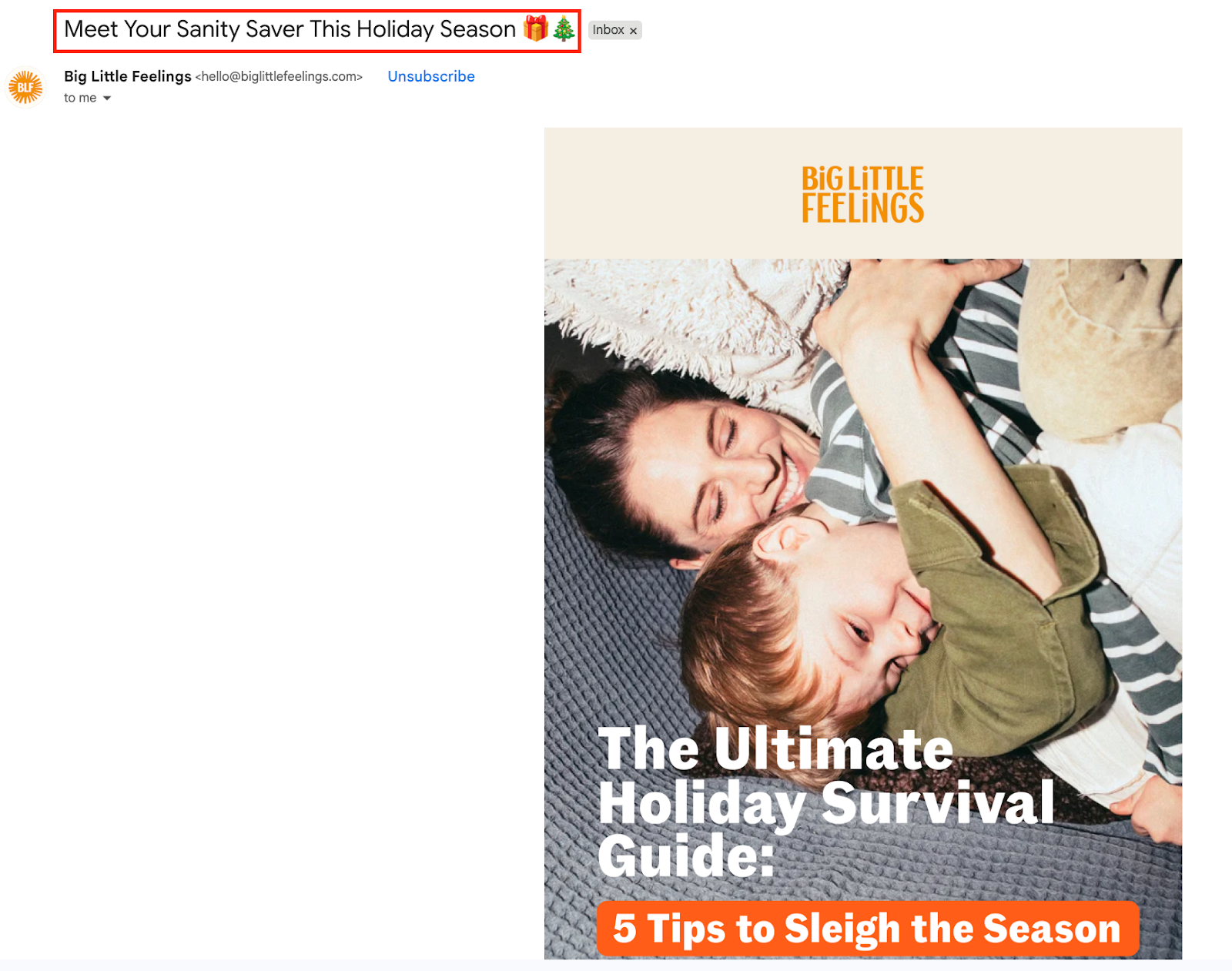
This subject line works because it directly addresses the emotional need.
It says holidays are overwhelming, and this email might help. There’s no pressure, urgency, or heightened tone. It signals: I see what you’re experiencing, and I have something that might make it easier.
But the best approach is not simply “add emotion.” It’s to generate different subject line versions and test the shift in tone and structure.
Run A/B tests that assess different versions, like:
- Descriptive vs concept-driven.
- Warm vs concise.
- Simple vs poetic.
Track open rates, reply rates, and spam complaints side-by-side to see which patterns resonate with your readers. This helps you refine your next subject line so it’s more effective and deliverable.
9. Use Trust-First Language in Financial, Legal, and Health Messaging
Some industries require more restraint because filters scan them more strictly.
Finance, legal, healthcare, and compliance-heavy messaging benefit from subject lines that emphasize clarity over emotion.
So if you’re offering options to refinance medical student loans, for example, you wouldn’t use a subject line like …
“Slash Your Payments FAST!!!”
This feels unstable and sales-driven. It signals pressure instead of support, which is exactly the kind of tone that sends off alarm bells for filters because it sounds risky.
A much better subject line would be:
“Lower interest options for medical professionals”
This communicates stability and trust. It’s calm, clear, and factual. It informs the reader what the email contains and why it’s relevant, without being pushy.
Wrap Up
The best subject lines are grounded in trust. They match the email content, acknowledge the reader’s context, signal value, and respect attention. They don’t use urgency tricks — they earn attention because they feel relevant and real.
Inbox filters reward this, and so do readers. Your sender reputation grows because your relationship grows.
But you won’t always nail your subject lines the first time.
This is where Writecream can help.
You can use it to generate variations, adjust tone, and refine phrasing so your subject line reflects the real value inside of the email without slipping into hype. Try Writecream today to create natural-sounding subject lines that appeal to humans and beat every email spam checker.