Brand voice is your company’s personality in words. It’s how you sound when you write a product update, answer a customer on social media, even launch a campaign. AI for brand voice helps businesses maintain a consistent tone across blogs, emails, and social media.
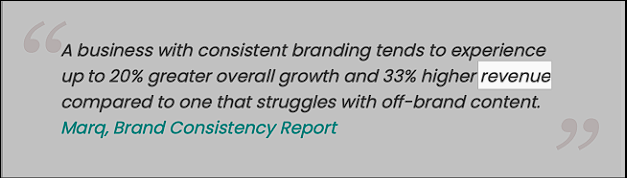
When your voice is consistent, customers feel like they’re talking to the same trusted person every time. That consistency pays off! Marq found that keeping your brand presentation consistent can bump revenue by up to 33% and boost growth by up to 20%.
But here’s where it gets tricky: How do you keep that voice steady when your content needs are exploding? New channels pop up. You’re entering new markets. New people join the team.
Before you know it, your tone starts drifting, and your messages sound generic. That’s where AI comes in.
When you use it right, AI works like a style-savvy teammate who remembers all your preferences. This tech can spread your voice across endless formats without flattening what makes you unique.
This page tackles the use of AI for your brand voice in content creation. Read on to learn how to train this tech to establish your voice and scale your content without losing your identity.
The Use of AI for Brand Voice in Content Creation
AI has gotten surprisingly good at matching tones. Give it some context, a few examples, and clear boundaries, and it can jump from writing playful product copy to reassuring support messages without breaking a sweat. There’s no magic here…just pattern recognition!
AI models are essentially pattern-matching machines. Feed them your best content examples along with clear guidelines, and they start picking up on subtle stuff. Think of your favorite phrase structures, the emotional tone you prefer, even the industry jargon you use. The trick is giving them lots of different examples that show your voice in action across various situations. AI for brand voice ensures every piece of content aligns with established brand guidelines.
Behind the scenes, large language models learn by guessing what word comes next based on massive amounts of text. With the right inputs (your best writing samples, clear rules, proper context), they can copy your style in a controlled way.
Today’s tools include:
- Prompt-based generators: They spit out quick drafts and help brainstorm.
- Retrieval-augmented generation (RAG): This pulls from your actual knowledge base to stay accurate.
- Fine-tuning: This model optimization teaches a model your specific style more deeply.
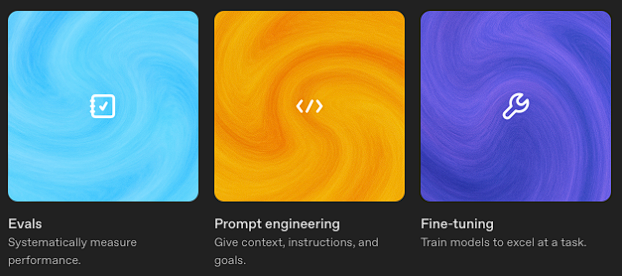
- Workflow tools: They combine AI with team collaboration, approvals, style checks, and more.
Companies are jumping on board fast. Gartner thinks that by 2025, 30% of marketing messages from big companies will be AI-generated. So, the real question isn’t whether you’ll use AI but how to use it without losing what makes your brand sound like you.
How To Get Started: Laying the Foundation of Your Brand Voice
Before you even look at an AI tool, you need to nail down your voice in plain English. Think of it as creating sheet music that AI will eventually play. That said, here’s how to get started:
- Pick your voice pillars: Consider three to five traits like “helpful, plainspoken, optimistic.” Make them short and memorable.
- Create a “do this, not that” list with actual examples. “Do: Use short, active sentences. Don’t: Stack on the jargon.” Show before-and-after rewrites.
- Make a brand dictionary and a list of banned words. Include how you write product names and what gets capitalized, not to mention phrases you never use.
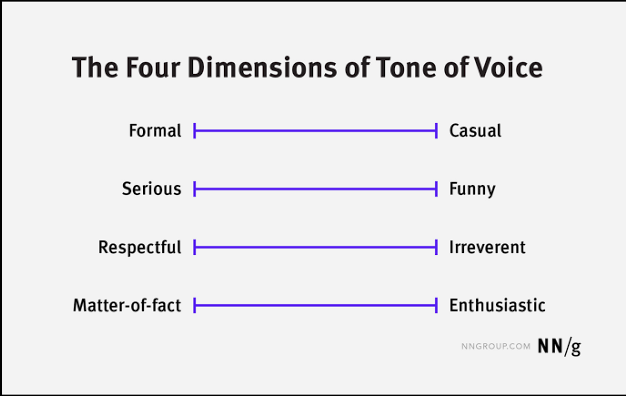
- Figure out your tone for different situations. How you apologize to a customer is different from how you announce a new feature. Check out NN/g’s The Four Dimensions of Tone of Voice:
- Set standards for clarity: Factor in what reading level you target and whether you use plain language (even accessibility requirements).
- Collect 10-20 pieces of your best content: Think of pages that convert well, emails people love, social posts that just felt right, etc.
How To Train AI for Brand Voice
With AI for brand voice, brands can deliver personalized messaging at scale. You don’t need a computer science degree or a private server farm to teach AI for brand voice. Start simple and improve as you go. Here’s the basic process:
1. Gather your best content
Start by pulling together those golden examples. Then, tag each one:
- Who it was for
- Where it appeared
- What it was trying to do
- What tone it used
Finally, make notes about why each piece works.
2. Turn your guidelines into clear instructions
The next step is to take your voice traits, do/don’t list, word choices, and situational tones. Then, write them as specific directions.
For example:
- Always use contractions.
- Say ‘you’ and ‘we’ instead of ‘the company.’
- Try to keep sentences under 20 words.”
3. Create reusable templates
For each type of content (product pages, blog posts, release notes, FAQs, etc), make a standard brief that includes:
- Who’s reading and why
- Your voice traits and rules
- Must-use terms and never-use phrases
- Target reading level, calls to action, formatting style
- Links to fact sources
From there, you can specify the following:
- Tone (Is it empathetic, sarcastic, inspirational, or any other?)
- Sentence length (short vs. long sentences)
- Vocabulary preferences
- Formatting (intros with hooks, bullet points, CTAs, etc.)
Also, train AI on your brand voice not only for written but also for spoken language.
Let’s say, you use AI voice in videos or AI-powered VoIP services for smart call routing or pre-recorded “Press 1,” “Press 2,” etc. AI lets you maintain your brand voice only if you train it using reusable templates.
4. Show good examples and restrict bad ones
Give the AI two to three great samples of whatever you’re asking it to write. Also, throw in one bad example too and explain what’s wrong with it. Finally, set restrictions for off-limits topics and vocabulary units. Using AI for brand voice reduces manual editing while improving messaging consistency.
Training AI isn’t only about telling it what content it should generate to align with your company’s voice. It’s also about limiting it and indicating what it shouldn’t mention under any circumstances.
Create the so-called “no-go areas” for specific topics. Do so for even exact words/phrases to keep AI writing respectful and culturally sensitive and in line with your brand voice, of course.
For example:
Suppose you’re a financial service provider that wants to explain California debt relief to Californians in a more informal way. Ask AI to do that, but indicate all the linguistic landmines to avoid.
The huge one? Never abbreviate “Californians” for “Cali” to refer to them informally. Many locals cringe at that nickname or even consider it offensive.
5. Connect your knowledge base
AI can only sound like your brand if it has access to your real information. Link your documentation, product details, and internal guides so it pulls facts from the right places instead of filling in the blanks on its own. RAG keeps everything grounded: Your tone and your details.
For example:
If you store your brand assets, product images, and updated messaging in your database for digital assets management, plug that into your AI workflow.
Now, when you ask AI to write a product page or support reply, it grabs the exact files and descriptions your team already approved. No guessing, no outdated info; just on-brand content backed by the right source material!
6. Localize your content
When training AI on your brand voice, don’t forget about content localization instructions to preserve your local identity.
For example:
Let’s look at NDIS providers in Sydney, Australia. Their overall brand tone is warm and supportive as they deliver disability care.
However, their blog articles are in Australian English (which typically follows the British spelling variant), targeting the local audiences in particular.
Also, their social media posts always go live with location-based hashtags. On TikTok, these are majorly #aussietok, australiatiktok, or #ndissydney.
7. Consider fine-tuning later
Once you’ve got your style locked down and you’ve tested plenty of prompts, you might fine-tune a model for content you create over and over. Skip this at first; It’s overkill until you’re really scaling.
Now, retrain AI after your brand voice updates. Just like your business, your brand voice won’t stay frozen in time forever. It will likely evolve into something new (in line with your new corporate vision and marketing strategy). And so, AI should be retrained accordingly!
For example:
Knowing that younger specialists (particularly Generation Z) are becoming bosses and executives today, an executive assistant staffing agency may decide it’s high time to refresh the brand voice and make it more Gen-Z-oriented.
How? By loosening the tone (just a bit) to sound more casual and using abbreviations or micro-phrases you can commonly hear from your execs: “Spin up a doc,” or “Give me the TL;DR.”
How To Implement AI-driven Content Creation
Rolling out AI is more about getting the process right than picking the perfect tool. Start where mistakes won’t hurt, and patterns are clear.
Learn from Raihan Masroor, Founder and CEO of Your Doctors Online. He has his fair share of leveraging AI to establish their brand voice as a thought leader in the digital healthcare sector.
Masroor suggests, “Let AI handle first drafts for routine stuff like product descriptions, FAQ answers, that kind of thing. Your writers should focus on strategy pieces and final polishing. This split lets you crank out more content while making sure everything still sounds right and feels human where it counts.”
Keep humans in the loop:
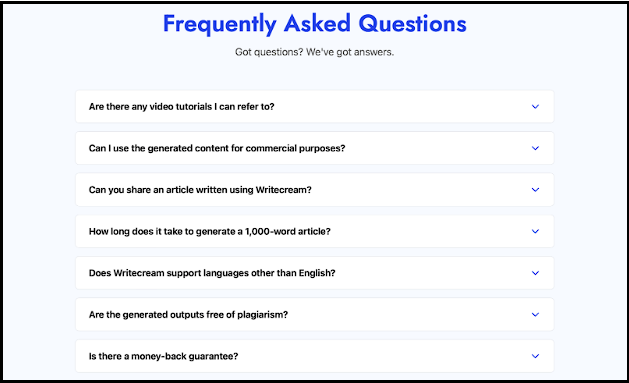
- Have AI draft the repetitive stuff. Consider product descriptions, meta tags, support responses, social media posts, and frequently asked questions (FAQs):
- Save humans for the complex work. Think of thought leadership, major campaigns, nuanced stories, and sensitive topics.
- Create an editing checklist. Does it sound like us? Is it clear? Are the facts right? Is it inclusive? Is it fresh?
- Time your edits. If editors spend ages fixing the tone rather than checking facts, your prompts need work.
- Have quality control. When you scale content, you need to scale your quality checks too. Make them visible and measurable. Track these metrics:
- Voice consistency: How well does it match your tone, vocabulary, sentence style, and CTA patterns?
- Speed gains: Time to first draft and editing time per piece
- Change requests: How often stakeholders request changes
- Data accuracy: Errors per 1,000 words, whether sources are cited
- Content performance: Click rates, reading time, customer responses
Challenges and Considerations for AI-driven Brand Voice in Content Creation
AI is powerful but imperfect. It needs boundaries and honest communication with your customers.
Common issues and fixes:
- Everything sounds the same: Fight this with specific examples, strict rules, and regular human editing.
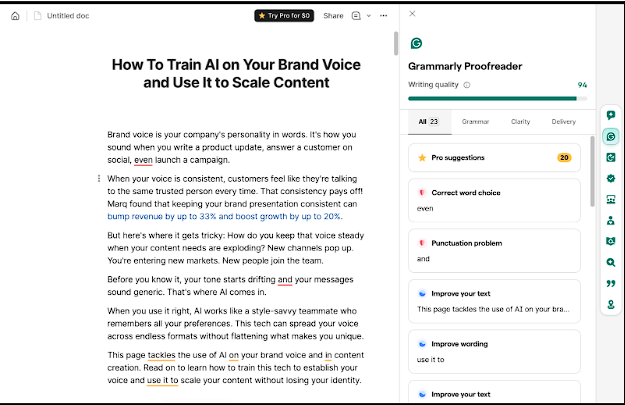
Image source: Grammarly
- Made-up facts: Always connect to your documentation. Require sources. Train the AI to say “I don’t know” when it should.
- Biased language: Check your output regularly. Build lists of problematic terms. Use plain language and diverse examples.
- Data security: Don’t paste confidential stuff into random tools. Work with legal on what data you can use for training.
- Team worries: Position AI as a creative boost, not a job replacer. Invest in new skills, such as AI editing and prompt writing.
Take it from Adrian Iorga, Founder and President of Stairhopper Movers. While he recognizes the power of AI for branding and content marketing, he understands the ethical issues and consumer hesitations surrounding it.
Iorga shares, “People respect honesty. When it makes sense, tell them you use AI to help create consistent, useful content faster. Frame it as something that enhances human creativity, not replaces it. This transparency actually builds trust by showing you’re innovative but still care about the human side.”
Final Note: The Future of Brand Voice with AI
When you do it right, AI lets you create more content without losing what makes your brand feel human. It protects your voice at scale and handles the tedious parts. It gives your team room to work on what matters. The potential is huge!
But what’s coming next? Expect better tools for keeping style on-brand, improved fact-checking through document retrieval, and more options beyond text, whether voice, video, or interactive content. We’ll also see clearer rules about giving credit and being transparent as teams get more comfortable working alongside AI. Implementing AI for brand voice streamlines workflows and boosts content efficiency.
Been waiting for the perfect moment? This is your sign to start. Begin small. Document your voice like you’re describing a person. Feed AI your best work. Keep humans involved. Build in feedback loops so your brand sounds unmistakably like itself, no matter how much content you create.
If you need help establishing your brand voice using AI, consider leveraging Whitecream’s all-in-one AI platform. This tool can help boost both your creativity and productivity in content creation while maintaining your brand voice. To get started, sign up today!