

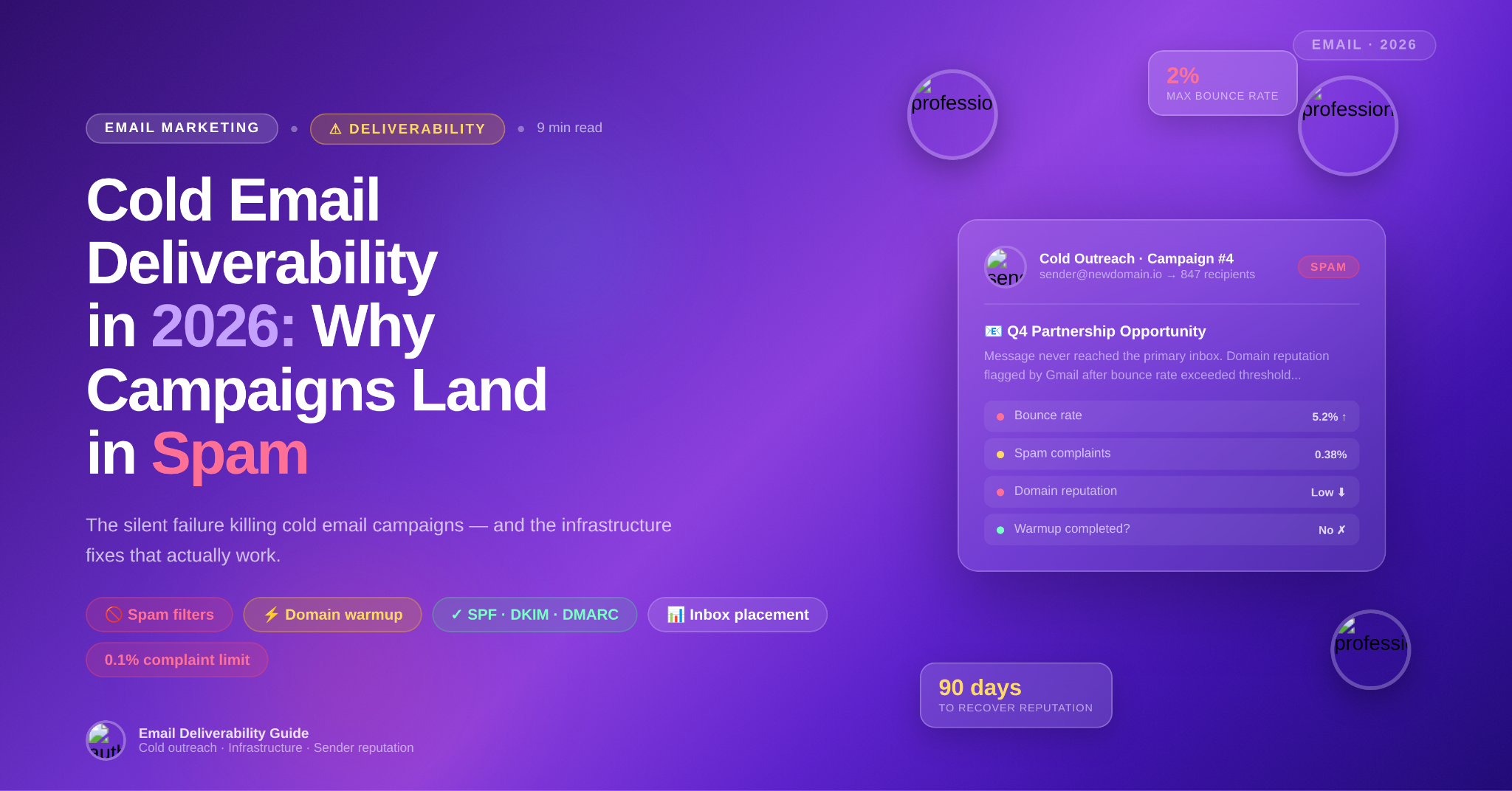
Most cold email problems get diagnosed in the wrong place. Teams rewrite subject lines, test new templates, swap sending tools, and watch reply rates stay flat. The actual issue is usually invisible to them: their messages are never reaching the inbox at all.
Deliverability is the part of email marketing that fails silently. No error message, no bounce notification in most cases — just a campaign that generates zero response because it's landing in spam folders no one looks at.
What Deliverability Actually Measures
Deliverability is not about whether an email was technically sent. It's about whether it reached the primary inbox of the intended recipient.
The infrastructure layer most senders ignore
Every email travels through a chain of decisions before it lands anywhere.
The sending mail server, the domain's DNS records, the IP address reputation, the receiving mail server, and the user's inbox provider all play a role in determining placement. Most senders focus exclusively on the content of the message and assume the infrastructure handles itself. It doesn't. A message from a domain with no sending history, missing authentication records, or a suspicious IP address will be filtered before the subject line is ever read.
How ISPs decide where a message lands
Gmail, Outlook, and Yahoo each maintain internal reputation systems that score sending domains and IP addresses based on accumulated behavior signals.
These signals include bounce rates, spam complaint rates, engagement ratios (what percentage of recipients open, click, or reply), the rate at which recipients delete messages without opening them, and whether the domain appears on any blocklists. The content of the message matters far less than the reputation of the sender. A beautifully written email from a flagged domain lands in spam. A mediocre email from a trusted domain lands in the inbox.
The Six Reasons Cold Email Ends Up in Spam
Understanding why campaigns fail at the deliverability level is more useful than guessing which subject line variation to test next.
No domain warmup before the first campaign
A domain that has never sent email at volume — or one that's been dormant for months — has no reputation with receiving ISPs. Sending a large batch of cold emails from that domain immediately triggers suspicion.
ISPs expect sending volume to grow gradually from new or returning domains. A domain that goes from zero to 500 sends on day one looks, from the outside, exactly like a spammer. The standard solution is a structured warmup: starting with low daily volumes and increasing them incrementally over several weeks, generating positive engagement signals along the way. Tools like Snov.io automate this process by running inbox-to-inbox interactions that build domain reputation before any real prospects ever receive a message. Skipping warmup is the single most common reason a well-planned cold email campaign produces zero results.
Missing or misconfigured authentication records
SPF, DKIM, and DMARC are the three authentication standards that ISPs use to verify a sender's identity. Together, they answer one question: does this email actually come from who it claims to come from?
SPF specifies which mail servers are authorized to send on behalf of a domain. DKIM adds a cryptographic signature to each message that the receiving server can verify. DMARC tells receiving servers what to do when an email fails SPF or DKIM checks, and where to send reports about failed deliveries. All three need to be configured correctly in the domain's DNS records before any outreach begins. Missing any one of them weakens the domain's credibility signal considerably.
Sending from a shared IP with a bad neighborhood
Not all sending infrastructure is equal. Shared IP addresses, used by many email marketing platforms at the lower pricing tiers, pool the reputation of every sender using that IP.
If another sender on the same IP gets flagged for spam, the IP's reputation suffers — and that affects everyone sharing it. This is less of an issue on dedicated IPs, where the domain is the only sender. For high-volume cold outreach, a dedicated IP with a clean history is always preferable to sharing.
High bounce rates from unverified lists
Sending to a list with a significant proportion of invalid addresses produces hard bounces that accumulate against the domain's reputation.
According to data from Validity's benchmark report on email deliverability, senders with bounce rates above 2% see measurable drops in inbox placement almost immediately. A cold email list built from LinkedIn exports, event attendee registrations, or purchased data almost always contains invalid addresses that haven't been verified. Running the list through SMTP verification before the first send removes those addresses before they do damage.
Spam complaints from irrelevant or unwanted messages
A recipient who marks a cold email as spam sends a signal directly to the ISP. Those signals accumulate, and ISPs weight them heavily.
Google's current guidelines for bulk senders set the acceptable spam complaint rate at 0.1%. Above that threshold, inbox placement starts degrading. A message that goes to a list that isn't well-targeted, or that arrives without a working opt-out mechanism, is far more likely to generate complaints than one sent to a relevant audience with a clear unsubscribe path.
Sending patterns that look automated
ISPs look for behavioral patterns that distinguish legitimate senders from automated spam operations.
Sending all messages at exactly the same second, using identical message structure for every recipient, and spiking volume without gradual growth are all signals that something non-human is generating the traffic. Modern spam detection doesn't need to read the message to identify these patterns — the metadata alone is enough.

Domain Reputation: What It Is, How It's Built, How It Breaks
Domain reputation is not a score you can see directly. It's an inference ISPs make from the pattern of your sending behavior over time.
The signals ISPs track beyond bounce rates
Bounce rate is the most talked-about reputation signal, but it's not the only one.
The ratio of opens to sends, the rate at which recipients reply, whether recipients move messages from spam to inbox (a strong positive signal), and whether the same recipients consistently engage across multiple campaigns all feed into the reputation model. A domain that generates high engagement from a small list outperforms a domain with a large list and low engagement every time.
What a damaged reputation looks like in practice
| Symptom | Likely cause | Immediate action |
| Open rate drops suddenly across all segments | Domain or IP flagged by major ISP | Check Google Postmaster Tools and Validity Sender Score |
| High open rate but zero replies | Landing in promotional tab, not primary inbox | Review sending volume and engagement ratio |
| Bounce rate above 3% in first campaign | Unverified contact list | SMTP verify entire list before next send |
| Spam complaint rate above 0.1% | Irrelevant audience or missing opt-out | Audit list targeting and add unsubscribe to all messages |
| Messages delivering normally to some ISPs but not others | Blocklist issue specific to that network | Run domain through MXToolbox blocklist checker |
Reputation damage is cumulative and slow to repair. A domain that exits a warmup period with poor reputation signals can take 60 to 90 days of clean sending to recover, even after the underlying problem is fixed.
The Technical Setup That Separates Deliverable Campaigns
Before sending a single cold email, the infrastructure checklist below should be complete. Skipping any of these creates a deliverability risk that content quality cannot compensate for.
- SPF record configured in DNS, listing all authorized sending servers for the domain
- DKIM record added to DNS with a minimum 2048-bit key, not the older 1024-bit standard
- DMARC policy set to at least p=none with a reporting address to receive failure data
- Domain warmup completed before any large-volume send, starting from 20 to 30 messages per day
- Contact list verified through SMTP before import, with bounce rate target below 2%
- Dedicated sending domain (separate from the main company domain) for cold outreach
- Opt-out mechanism included in every message, processed within 10 business days
- Google Postmaster Tools set up for the sending domain to monitor reputation in real time
Each item on this list addresses a specific failure mode. Domains that skip the dedicated subdomain step, for example, risk damaging the primary company domain if a campaign generates high complaints — affecting transactional email, sales proposals, and support communications.
What Changes in 2026: The Deliverability Landscape Shift
The rules governing email deliverability tightened considerably in 2024 and have continued evolving since.
Google's requirements that are now mandatory
Google and Yahoo's 2024 bulk sender requirements made SPF, DKIM, and DMARC mandatory for anyone sending more than 5,000 messages per day to Gmail addresses.
More significantly, Google introduced a one-click unsubscribe requirement and began enforcing the 0.1% spam complaint threshold more aggressively. These weren't soft guidelines — accounts that failed to meet them started seeing deliverability degradation. For cold email senders in 2026, compliance with these requirements isn't optional, even for lower-volume senders, because the infrastructure habits built at low volume determine whether scaling up is even possible later.

Why open rate stopped being a useful deliverability metric
Apple's Mail Privacy Protection, introduced in 2021 and now widely adopted, pre-fetches tracking pixels before the user opens an email. This inflates open rates artificially for any list with a significant proportion of iOS users.
For cold email specifically, this means open rate can no longer be used to diagnose deliverability problems accurately. A campaign might show a 35% open rate while most of those "opens" are automated pixel fetches, not actual human eyes. The metrics that remain reliable are click-through rate, reply rate, and direct conversion tracking. Deliverability itself is best monitored through Google Postmaster Tools, which shows domain reputation data independently of how a campaign's opens are counted.
Conclusion
Cold email deliverability in 2026 is a technical problem as much as a copywriting one. Domain warmup, authentication records, list verification, and complaint rate management are the inputs that determine inbox placement. Getting those right doesn't guarantee a good reply rate — but getting them wrong guarantees a campaign that never had a chance to begin with.
Join Writecream for FREE!
In a few clicks and under 30 seconds, generate cold emails, blog articles, LinkedIn messages, YouTube videos, and more — no credit card required.
Start for FREE