Whether you’re scaling a startup or refining a personal brand, an AI bio generator can be the tool that finally moves “update social copy” off your to-do list.
But while automation promises speed, the real challenge is maintaining a voice that doesn’t sound like a robot wrote it.
I have analyzed the trade-offs of using these generators for both personal and professional branding. This guide breaks down when to use one and when you need to step back in to ensure your “about me” actually sounds like you.
The pros of using an AI bio generator
Automation is winning because it treats bio-writing as a scalable system rather than a creative chore.
For founders and brands, especially those already utilizing tools like shopping engine search monitoring to maximize their digital presence, the benefits go beyond just saving time.
- Hyper-personalization at scale: Modern tools can instantly adapt a single core bio into 10 different versions, turning the tone authoritative for a LinkedIn summary while making it edgy and concise for X.
- SEO and discoverability: AI doesn’t write. It optimizes. By analyzing high-ranking profiles in your niche, generators can automatically weave in semantic keywords and industry-standard terms that help your profile show up in both platform searches and Google AI Overviews.
- Accessibility and cost savings: One of the biggest advantages of AI tools is their accessibility. For freelancers and early-stage entrepreneurs, the high cost of professional headshots and brand copywriting can be a significant barrier. A standard studio session can cost around $283 on average, which doesn’t even include the cost of a professional bio writer. Using an AI-powered bio generator allows you to allocate those limited resources to other areas, while ensuring your brand voice remains consistent and professional across all platforms.
- Eliminating the “blank page” friction: For many, the hardest part of branding is the initial draft. AI acts as a structural coach, providing a professional framework that you can refine, which reportedly reduces content creation time by up to 75%.
- Brand consistency across teams: For companies, AI ensures that 50 different employee bios all reflect the same corporate values and tone. By using brand voice settings, you can ensure the human element of your team remains aligned with the company’s visual identity.
The cons: Where AI falls flat in generating bios
Despite the efficiency gains, pure AI output carries significant risks that can damage a brand’s reputation if left unedited.
As users become more tech-savvy, the “AI sheen” (that overly polished, slightly generic tone) has led to a growing demand for “human messiness” and authentic imperfection.
- The loss of “human messiness”: AI struggles to capture the unique pivots, emotional nuances, and the unflashy personal stories that actually build trust. A social media profile that’s too perfect often feels like a template, which can alienate audiences looking for a genuine human connection.
- Privacy and data sovereignty: One of the most significant and underreported downsides of AI bio generators is the security risk they introduce at scale. The same technology that helps professionals craft polished LinkedIn summaries is increasingly being used by attackers to generate convincing fake personas for spear phishing campaigns, complete with plausible career histories, professional headshots created by AI image tools, and writing styles that closely mirror real colleagues. As these synthetic identities become harder to detect, organizations are turning to the top security awareness training providers to ensure their employees can recognize AI-engineered social engineering before it reaches an inbox, because the same AI capability that writes your bio can also write the phishing email targeting you.
- Hallucinations and inaccuracy: Because AI operates on probabilistic patterns rather than verified facts, it can sometimes “hallucinate” achievements or job titles that sound plausible but are entirely false. For high-stakes professional profiles, a single factual error can destroy years of built-up credibility.
- Algorithmic bias: Since AI models are trained on historical data, they can unintentionally reproduce societal biases. This might manifest as a bio that uses gendered language or fails to accurately represent cultural nuances, leading to a profile that feels tone-deaf or exclusionary.
At a glance: Top 9 AI bio generators
In this section, we take a closer look at the heavy hitters in the bio-generation space. While most of these tools use similar underlying technology, their “personalities” vary wildly. Some are built for the rapid-fire pace of social media, while others are geared toward long-form professional storytelling and SEO.
Below, I’ve broken down the standout features and ideal use cases for the top 9 bio generator tools to help you identify which one aligns with your specific workflow.
Writecream
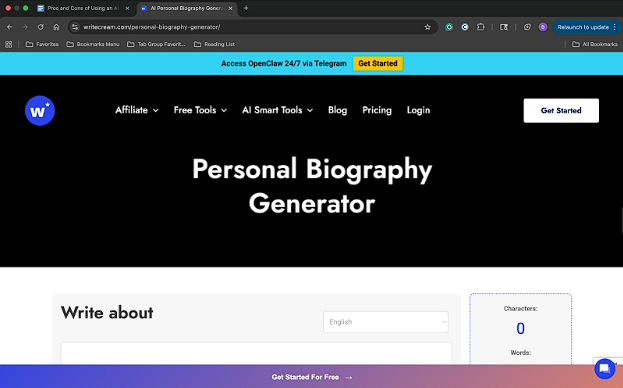
If your bio feels like a polished script that readers immediately skip, you’re likely hitting a common branding wall. Most tools produce that which lacks tension or a reason for the audience to stay. Writecream addresses this by shifting the focus from looking perfect to feeling authentic.
It turns the profile bottleneck into a repeatable system for content that feels organic but performs with machine-like efficiency. Using personalized icebreakers creates an entry point that functions as a recommendation rather than a standard sales pitch.
Key features:
- AEO and GEO optimization
- Lexi SEO Agent
- Backlink Autopilot
Best for: Founders, marketers, and brands seeking an all-in-one solution to scale their online presence while maintaining search-first visibility.
Jasper AI
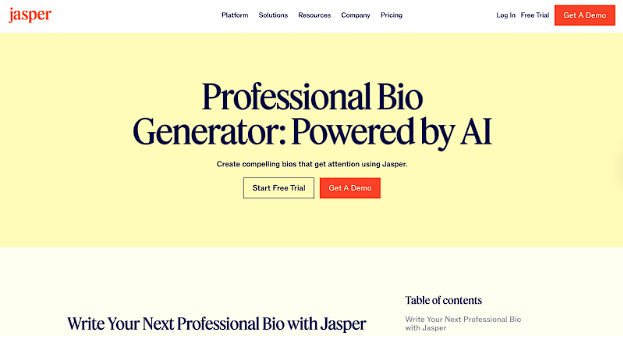
Jasper is a great option for professionals who need to maintain a strict brand voice across multiple channels and maintain a consistent online presence.
It allows you to upload existing content to train the AI on your specific style, ensuring that even automated bios sound like they were written by your internal team. So, think of it as your personalized bio generator.
Key features:
- Custom brand voice training
- Multi-language support
- Robust Knowledge Base for factual accuracy
Best for: High-growth startups and established brand profiles
Copy.ai
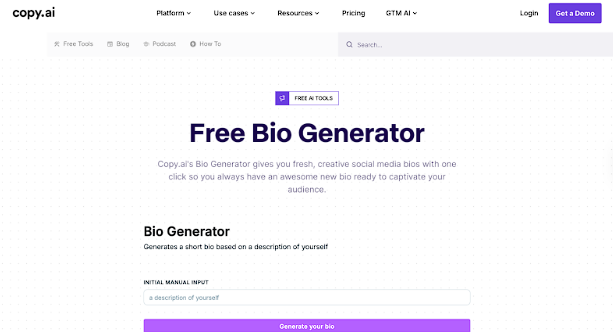
Copy.ai excels at removing the friction of manual prompting by offering highly specific templates for different social media platforms. It’s built for speed, allowing you to generate dozens of bui variations for A/B testing in the time it takes to write one by hand.
Key features:
- Platform-specific workflows
- Vast library of templates
- Intuitive chat interface for real-time edits
Best for: Social media managers handling multiple brand accounts
Writesonic
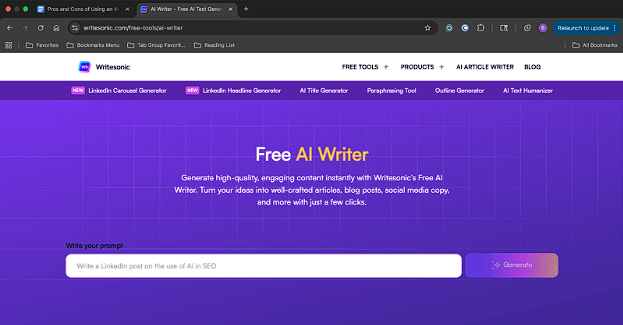
Writesonic focuses on the intersection of SEO and personality, making it a strong choice for “Meet the Team” pages or author boxes.
It leverages real-time data to ensure your bio is not only creative but also optimized for the keywords that drive discoverability in your niche.
Key features:
- SEO-integrated writing
- Brand voice settings
- Built-in paraphrase to refine awkward phrasing
Best for: Content creators and bloggers who need to rank in search results
Rytr
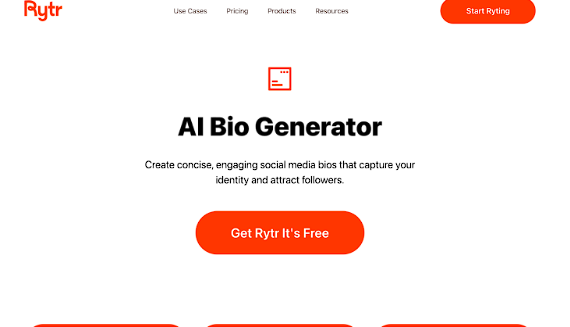
Ryter offers a streamlined, distraction-free writing experience that’s perfect for individuals who want personal branding without a steep learning curve. It’s one of the most affordable options on the market.
Key features:
- 20+ distinct tones to choose from
- Built-in plagiarism checker
- Clean browser extension
Best for: Freelancers and job seekers building personal profiles
Hyoptenuse AI
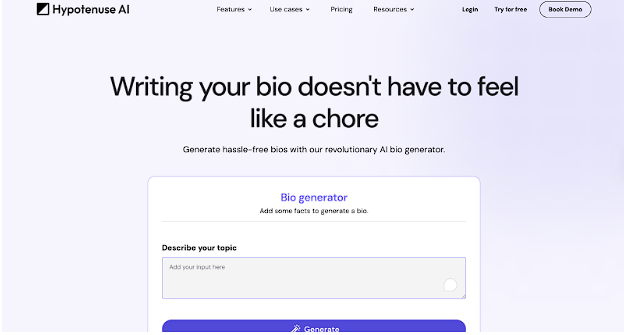
Hypotenuse AI uses a unique fact-check approach that requires you to input specific achievements or talking points before it begins writing.
This ensures that the generated bio is grounded in your actual career highlights and key details rather than generic AI fluff.
Key features:
- Guided input prompts
- High-quality batch generation
- An “airy” interface
Best for: Executives and founders with specific, data-driven achievements to highlight.
Simplified AI
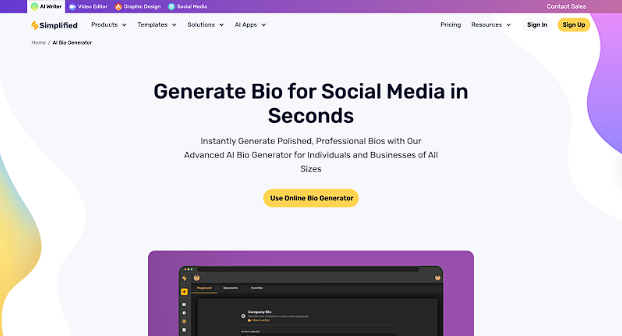
Simplified is an all-in-one creative suite that treats the social media bio as one part of a larger brand identity. Because it integrates with design and video tools, you can instantly turn your new captivating bio into a LinkedIn banner or a social media graphic.
Key features:
- Integrated design workspace
- AI image generator
- Dedicated social media scheduler
Best for: Solopreneurs who need to manage their entire visual and written presence in one place
Ahrefs AI Bio Generator
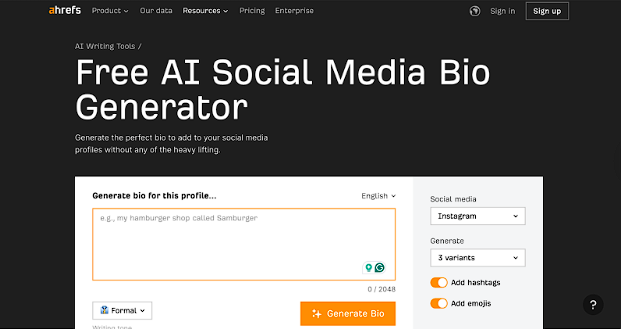
Part of the Ahrefs free writing suite, this tool is surprisingly sophisticated for a free utility. It allows you to select your target platform, whether it’s TikTok, LinkedIn, or Instagram, and it adjusts the character count and “vibe” accordingly.
Key features:
- Platform-specific character constraints
- Variety of tone options
- High-speed output
Best for: Influencers and personal brands looking for quick, platform-ready copy
Originality.ai Bio Generator

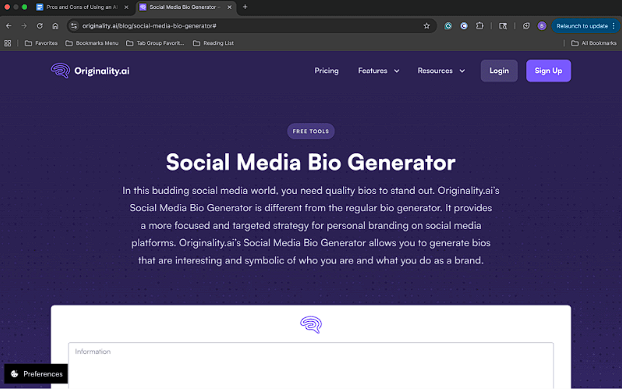
Originality focuses on human-sounding content that’s designed to pass AI detection filters. This is a critical tool for guest authors or academic professionals who want to ensure their automated bio doesn’t trigger AI-written red flags.
Key features:
- AI-detection scores
- Focus on natural phrasing
- Readability analyzer
Best for: Guest posters, academics, and high-trust professional profiles
How to use AI without looking like a bot
To use an AI bio generator for your personal or brand bio without looking like a bot, you have to break the patterns of perfect symmetry that characterize machine output.
Today, authenticity is about the unique, sometimes messy details that a model can’t hallucinate.
- Apply the 70/30 rule: Use AI for 70% of the heavy lifting (e.g., structure, keywords, length constraints), but reserve the final 30% for your team’s voice. This is where you add specific opinions, niche achievements, or the human soul that a model can’t replicate.
- Vary sentence structure: AI typically produces predictable, medium-length sentences. To sound human, vary your burstiness by mixing short, punchy statements with longer, more descriptive reflections. If three sentences in a row look identical in length, break one.
- Audit for “AI fingerprints”: Machines lean heavily on specific buzzwords that act as red flags for readers. Scan your draft and remove corporate cliches like “leverage,” “transform,” “delve,” or “in today’s digital age.” Replace them with grounded, simple alternatives like “use,” “change,” “look into,” or “now.”
- Include hyper-specific details: AI is vague. Humans are specific. Instead of saying you “drove growth,” state that you “helped a 3-person team hit $1.2M ARR in 14 months.” Adding one unique metric or name makes the content impossible to hallucinate.
- The read-aloud test: Read your bio out loud. If you stumble over formal transitions like “furthermore” or “moreover,” cut them. If the tone doesn’t sound like something you’d say over coffee, it isn’t for your profile.
Conclusion: Finding your flow in the AI era
Using an AI bio generator shouldn’t replace your identity. But it should remove the friction of a blank page.
So, AI provides the draft, while you provide the soul.
The most high-performing profiles in 2026 are those that lean into efficiency and heavy lifting, but keep a human hand on the wheel for the final polish.
Ready to put this into action? Get started with Writecream and start building a bio that converts.